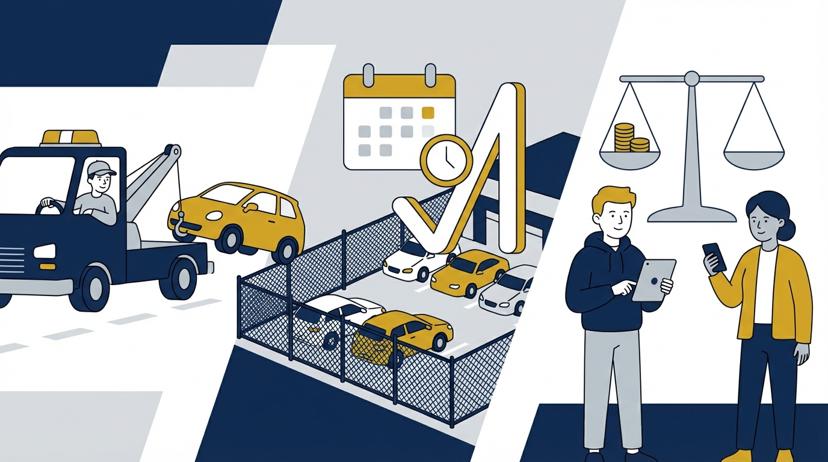
Towing storage fee limits are governed by state laws that cap daily rates, hookup fees, and notice requirements. In many states, facilities cannot charge for the first 24 hours or must send a certified letter before fees accrue. If the underlying repair was unauthorized, the storage fees may be legally unenforceable.
Key Takeaways
- Daily storage rates and hookup fees are strictly capped by state or local statutes.
- Facilities must often provide formal written notice before they can legally collect storage fees.
- Consumers generally have a legal right to retrieve personal property without paying the storage bill first.
- Storage fees are often unenforceable if the initial repair dispute involves unauthorized work.
When an auto repair dispute escalates, a vehicle often ends up in a storage lot or a vehicle storage facility (VSF). This usually happens when a consumer refuses to pay for unauthorized repairs or when a shop claims a mechanic's lien and has the vehicle removed from their premises. The resulting daily charges can quickly exceed the value of the car itself. Understanding towing storage fee limits is the first step in preventing a repair dispute from turning into a total financial loss.
While many consumers feel helpless when a tow yard or repair shop holds their keys, state laws provide specific protections. These rules dictate how much a company can charge, how they must notify the owner, and what happens if those fees are padded with "administrative" costs. Trials are slow, expensive, and often unnecessary; the goal is to use these regulations to seek a settlement long before a judge ever sees the case.
The Landscape: Why Storage Fees Are the "Hidden Tax" of Repair Disputes
In the world of auto repair, storage fees are often used as leverage. If a consumer in Texas disputes a bill that is $500 higher than the original estimate, the shop might threaten to charge $50 per day in storage fees until the bill is paid. This creates a "ticking clock" that pressures the consumer to drop their legitimate complaint just to stop the financial bleeding.
The landscape of these fees is a patchwork of state statutes and local ordinances. Some states, like Virginia, have strict statewide caps. Others, like New Jersey, leave much of the regulation to local municipalities. Regardless of the location, the common thread is that storage fees must be "reasonable" and, in many cases, cannot be charged at all unless specific notice requirements are met.
When a vehicle is towed involuntarily—meaning the owner did not request the tow—the protections are even higher. These laws exist to prevent "predatory towing," where a shop and a tow company collude to rack up thousands of dollars in fees on a vehicle involved in a simple repair disagreement. By identifying the specific towing storage fee limits in a given jurisdiction, a consumer shifts the power dynamic from the shop back to themselves.
5 Key Rules Governing Towing and Storage Charges
Navigating the complexities of vehicle storage requires looking at specific state examples. While the numbers change, the logic remains consistent: the law generally disallows "surprise" fees.
1. Daily Rate Caps and the 24-Hour Rule
Many jurisdictions limit how much can be charged per 24-hour period. For example, in Massachusetts, the maximum storage charge for a passenger vehicle that has been involuntarily towed is $35 per 24-hour period.
Furthermore, some states prevent "double-dipping" during the first day. In Virginia, no storage fees can be imposed during the first 24-hour period of storage. If a car is towed at 10:00 PM and picked up at 8:00 AM the next morning, the storage fee should effectively be zero, even if a hookup fee applies.
2. The Requirement of "Written Authorization"
In Texas, a Vehicle Storage Facility (VSF) cannot charge for storage unless they comply with strict notice rules. According to Texas.gov, if a vehicle is not claimed within a certain timeframe, the facility must send a certified letter to the registered owner. If they fail to send this notice within the statutory window, they may be barred from collecting storage fees for the days preceding the notice.
In an auto repair context, if a mechanic in Houston moves a car to a storage lot because the owner won't pay for an unauthorized engine swap, the storage lot must follow these notice rules. If they don't, the consumer has a powerful argument to have those fees waived entirely.
3. Maximum "Hookup" and Initial Towing Fees
The initial tow is often the most expensive part of the bill, but even this has limits. Under Virginia Law Section 46.2-1233.1, the hookup and initial towing fee for a passenger car cannot exceed $210.
If a consumer in Virginia receives a bill for a $500 "emergency tow" from a repair shop to a storage yard, that bill is likely illegal. Highlighting this violation in a formal demand letter checklist can often convince a shop to release the vehicle rather than risk a consumer protection lawsuit.
4. Limitations on "Junk Fees"
Tow yards and repair shops often add administrative fees, "gate fees" (for picking up a car after hours), or "tarping fees" (for covering a broken window). Consumer protection laws state that these fees must be justified. In many states, if a fee is not explicitly listed in the state’s fee schedule, it cannot be charged. For instance, if a local ordinance in Florida caps storage at $30, the facility cannot circumvent this by charging a $50 "inventory fee" every day.
5. Access to Personal Property
A common tactic used by storage facilities is refusing to let a consumer get their house keys, medicine, or child seats out of the car until the tow bill is paid. In many jurisdictions, including California and Texas, this is illegal. Consumers generally have a right to retrieve personal property from a stored vehicle without paying the storage lien first. Denying this access can be used as evidence of "bad faith" in future disputes.
What Most People Miss: The Link Between Repairs and Storage
The most critical nuance in auto repair disputes is that storage fees are often "derivative." This means if the underlying reason for the storage is illegal, the storage fees themselves may be unenforceable.
Consider a scenario in New York. A consumer takes their car in for a $200 brake pad replacement. The shop performs a $2,000 transmission flush without authorization. When the consumer refuses to pay the $2,000, the shop moves the car to their back lot and starts charging $75 a day in storage.
Under Auto Repair Laws New York, shops must provide a written estimate and receive authorization before performing work. If the shop violated this law, they have no legal right to hold the car. Because the "debt" they are claiming is invalid, their "lien" on the vehicle is also invalid. In this case, the consumer isn't just fighting the towing storage fee limits; they are fighting the shop's right to charge storage at all.
Attorneys typically recommend looking for these "threshold violations." If the mechanic failed to provide a written estimate (a requirement in California and Texas), any storage fees they charge while "waiting for payment" are likely uncollectible. The storage fee is not a standalone problem; it is a symptom of the shop’s failure to follow repair laws.
The Superior Way: Resolving the Standoff with DemandDraft
When a car is sitting in a lot and fees are mounting, most people think their only options are to pay the bill or sue in Small Claims Court. However, filing a small claims court case against a mechanic can take months. During those months, the storage fees continue to grow, often exceeding the court's jurisdictional limit.
The superior approach is to use a Formal Demand Letter to seek a resolution quickly, without waiting months for court. This is where DemandDraft provides a strategic advantage.
How the Mechanism Works
The DemandDraft platform doesn't just ask for the car back; it uses the shop's own paperwork and the state's rules to make a clear, formal demand. The process follows a specific logic:
- Lay Out the Facts: The platform organizes the details of the dispute (e.g., whether there was a written estimate, whether the bill exceeded the estimate by more than 10%, and the towing storage fee limits).
- Apply the Law: Instead of vague complaints, the demand letter cites specific statutes. For example, it might cite the Texas Occupations Code regarding vehicle storage facilities.
- The "Failure State" Warning: The letter clearly outlines that if the car is not released and the fees waived, the next step is not just a lawsuit, but a report to the Bureau of Automotive Repair (BAR) or the state's licensing board.
- Professional Execution: By generating a professional, rule-based demand, the consumer signals that they know the small claims lawyer rules and are prepared to hold the shop accountable.
Case Study: The "Unauthorized Tow"
A consumer in California had their car at a shop for a warranty repair. The shop claimed the mechanic voided the warranty due to "misuse" and demanded $4,000. When the consumer disputed this, the shop towed the car to a third-party lot.
Instead of paying, the consumer used a tailored demand letter. The letter pointed out that the shop failed to provide a teardown estimate before looking at the engine—a violation of California's Business and Professions Code. Because the initial teardown was unauthorized, the shop had no right to charge for the repair or the subsequent storage. Faced with a formal demand that documented these specific violations, the shop paid the tow yard to release the car and dropped the $4,000 claim.
Why This Wins
Shops and tow yards rely on consumer ignorance. They assume the owner will eventually "break" and pay the fees to get their car back. A formal demand letter breaks this assumption. It proves that the consumer has a documented trail of evidence and knows exactly which laws have been broken. The "bottom line" is that it is cheaper for the shop to release the car than to defend a consumer protection claim where they might have to pay triple damages and attorney fees.
Strategic Application: How to Protect Your Vehicle
If a vehicle is currently being held and storage fees are accruing, the consumer must act immediately. Documentation is the most powerful tool in this process.
- Request an Itemized Bill: Demand a full breakdown of all towing and storage charges. Look for "administrative" or "processing" fees that may exceed local caps.
- Check the Timeline: Compare the date of the tow with the date you were officially notified. In many states, fees cannot be charged for the days before you were notified.
- Verify the License: Ensure the storage facility is licensed by the state. In Texas, for example, VSFs must be licensed by the Texas Department of Licensing and Regulation (TDLR).
- Send the Demand: Do not rely on phone calls or "stopping by" the shop. These interactions are rarely documented and often escalate into unproductive arguments. A formal letter creates a paper trail that can be used in court if necessary, but its primary purpose is to settle the matter immediately.
By focusing on the rules—like the specific towing storage fee limits and the requirement for written repair authorizations—consumers can stop the clock on predatory fees. Trials are a last resort. A well-crafted demand letter is often all it takes to show a shop that their "leverage" is actually a legal liability.
Start your demand letter to start the resolution process today. Start your letter now.
Frequently Asked Questions
Can a shop charge storage fees for unauthorized repairs?
Generally no. If the underlying repair was illegal or performed without a written estimate, the shop usually has no legal right to claim a lien or charge storage fees.
How much are towing storage fees per day?
Limits vary by state. For example, Massachusetts caps involuntary storage at $35 per day, while Virginia prohibits storage charges during the first 24 hours.
Can I get my belongings out of a towed car without paying?
Yes. In many jurisdictions, including California and Texas, it is illegal for a storage facility to withhold personal items like medicine or child seats while waiting for payment.
What is a junk fee in towing?
Junk fees are unauthorized charges like 'inventory fees' or 'administrative costs' that are not explicitly permitted by the state's official fee schedule.
How can I stop storage fees from mounting during a dispute?
The most effective way is to send a formal demand letter citing specific state fee limits and repair laws to push the shop to release the vehicle.