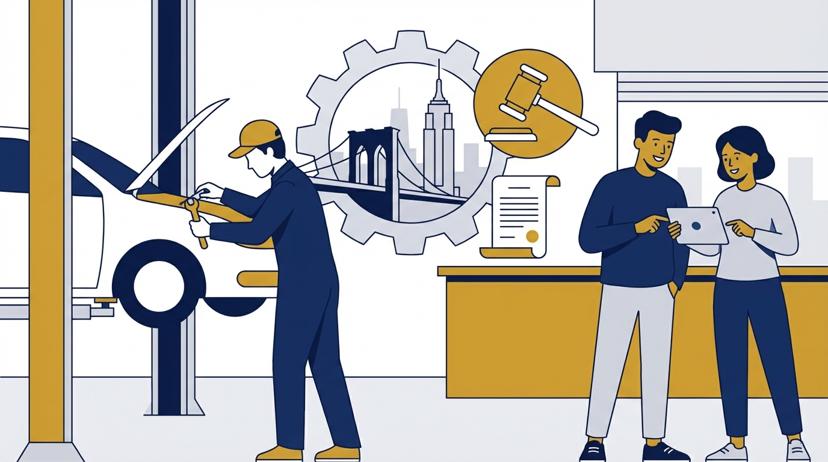
New York auto repair laws, governed by the Motor Vehicle Repair Shop Act, protect consumers by requiring written estimates, detailed invoices, and the return of replaced parts. If a shop performs unauthorized work, they cannot legally collect payment. Consumers have 90 days or 3,000 miles, whichever comes first, to file a DMV complaint to seek restitution for disputes.
Key Takeaways
- You have a legal right to a written estimate before any repair work begins.
- Shops must provide a detailed invoice listing all parts used and labor performed.
- You can request and keep any parts that were replaced during the repair process.
- Unauthorized repairs are generally uncollectible under New York state law.
- The DMV complaint window for auto repair disputes is 90 days or 3,000 miles after the repair, whichever comes first.
Navigating the world of vehicle maintenance in the Empire State requires more than just a basic understanding of engines; it requires a firm grasp of auto repair laws new york. Whether dealing with a transmission shop in Queens or a general mechanic in Albany, consumers are protected by a specific set of regulations known as the Motor Vehicle Repair Shop Act. This law exists because the power dynamic between a shop and a car owner is naturally unbalanced. By understanding the legal requirements for estimates, invoices, and authorizations, a consumer can transform from a frustrated customer into an empowered advocate.
The reality of the automotive industry is that disputes are common. From "mechanic guessing" to outright overcharging, the financial stakes are high. However, jumping straight into a lawsuit is rarely the most efficient path. Trials are slow, expensive, and often unnecessary if the right pressure is applied early. The most effective way to resolve a dispute is to use the existing legal framework to seek a settlement before a courtroom ever becomes necessary.
The Landscape: Why New York Auto Repair Laws Matter
New York has some of the most robust consumer protection frameworks in the country regarding automotive service. The New York State Department of Motor Vehicles (DMV) oversees the registration of all repair shops, ensuring they meet specific standards of conduct. Under the Repair Shop Act, thousands of dollars are returned to consumers annually through mediation and restitution.
The core of these protections lies in documentation. In New York, the law prioritizes the written word over verbal promises. This creates a "paper trail" that serves as the primary weapon for a consumer in a dispute. When a shop fails to follow these procedures, they aren't just being disorganized; they are often in violation of state law. Understanding these rules is the first step in moving from a position of "he-said, she-said" to a position of legal authority.
5 Key Pillars of Auto Repair Laws New York
1. The Right to a Written Estimate
Under New York law, a consumer has the right to receive a written estimate for parts and labor before any work begins. This is not just a courtesy; it is a requirement if requested by the customer. The shop may charge a reasonable fee for the estimate, but they cannot perform work that exceeds the estimated price by a significant margin without obtaining additional oral or written consent. If a shop performs work without this authorization, they may be in violation of Section 398-D of the Motor Vehicle Repair Shop Requirements.
2. Mandatory Detailed Invoices
Once the work is completed, the shop must provide a detailed invoice. This document is required to describe every service performed and every part supplied. It must also state whether the parts used were new, used, or rebuilt. If a consumer is charged for unauthorized repairs, the invoice serves as the primary proof of the shop's overreach. A vague invoice that simply lists "engine repair - $2,000" is a red flag and a likely violation of state regulations.
3. The Return of Replaced Parts
New York drivers have the right to inspect and keep any parts that were replaced during the repair process. To exercise this right, the consumer must request the parts at the time the car is dropped off. If the work is covered under a warranty, the shop may be required to return the parts to the manufacturer, but the consumer still has the right to inspect them. This prevents a common tactic where a shop claims to have replaced a part that was actually still functional or was never replaced at all.
4. DMV Registration and Public Posting
Every legitimate repair shop in New York must be registered with the DMV and display a green and white "Registered State of New York Repair Shop" sign. Additionally, shops are required to post a "Consumer Bill of Rights" and their labor rates in a visible location. If a shop is operating without a valid registration, they are essentially an "unregistered" entity, which significantly increases the consumer's leverage in a dispute. Dealing with an unregistered shop is a major risk, but it also means the shop has zero legal standing to enforce a mechanic's lien.
5. The 90-Day Complaint Window
Time is of the essence in New York. The DMV will generally only accept complaints against a repair shop within 90 days or 3,000 miles of the repair, whichever comes first. This creates a sense of urgency. If a consumer waits too long to take action, they lose the administrative support of the DMV. This is why it is critical to move quickly from a verbal complaint to a formal demand letter to preserve rights and establish a timeline of the dispute.
What Most People Miss: The Power of the "Failure to Authorize"
Most consumers believe that if a mechanic fixes a car, the mechanic deserves to be paid, regardless of the process. However, auto repair laws new york are very clear: work performed without authorization is often uncollectible.
If a shop calls to suggest a $500 brake job and the consumer agrees, but the final bill includes a $1,200 suspension repair that was never discussed, the shop has violated the law. Attorneys typically recommend that consumers never pay for work they did not authorize. In New York, if a shop refuses to release a vehicle because the owner won't pay for unauthorized work, the shop may be guilty of "illegal detention" of the property.
The nuance that most people miss is that the burden of proof is on the shop to show that authorization was given. If there is no signed estimate or a recorded log of a phone call where the consumer gave the "go-ahead," the shop is in a weak legal position. This is a common scenario when a mechanic is guessing at the consumer's expense, swapping parts blindly hoping to find a fix without getting proper approval for each step.
Why Small Claims Court is Often the Wrong First Step
When a dispute reaches a boiling point, the instinct is to "sue the mechanic." While suing a mechanic in New York is an option, it should be viewed as a last resort. Small Claims Court in New York City or other NY jurisdictions has limits (often between $5,000 and $10,000) and can take months to reach a hearing.
The "failure state" of a dispute is the courtroom. In court, a judge decides the outcome, and there is always a risk of losing. Furthermore, even if a consumer wins a judgment, they still have to collect the money, which can be another uphill battle.
Instead of jumping into the slow gears of the judiciary, the goal should be to push the shop to settle. Shops hate three things: DMV investigations, negative online reputations, and formal legal notices that prove the consumer knows the law. A well-crafted demand letter targets all three of these fears.
The Superior Way: Using a Formal Demand Letter to Resolve the Dispute
The most effective mechanism for resolving an auto repair dispute is a professional, formal demand letter. This is not a "complaint email" or a heated text message. It is a structured document that outlines the facts, cites specific auto repair laws new york, and sets a clear deadline for a resolution.
This approach works because it changes the shop's risk calculation. When a shop receives a letter that correctly identifies a violation of the Motor Vehicle Repair Shop Act, they realize that the consumer is prepared to escalate. They see that the "paper trail" is already organized and that a DMV complaint or a Small Claims filing is the inevitable next step.
A formal demand letter serves several purposes:
- It creates a permanent record: It documents exactly what happened and when.
- It demonstrates authority: By citing specific laws, it proves the consumer cannot be easily intimidated.
- It offers an "out": It gives the shop a chance to fix the problem (via a refund or repair) without the cost of litigation.
Most shops would rather refund a $500 overcharge than deal with a DMV investigator auditing their registration or spending a day in court. This is the logic behind the DemandDraft mechanism. By using a platform built around New York's auto repair rules, consumers can generate a formal letter without the high cost of hiring an attorney.
Strategic Application of New York Law
To successfully resolve a dispute, a consumer must apply these laws strategically. For example, if a shop in Brooklyn claims they don't provide written estimates, the consumer should immediately reference the NYC Administrative Code or the state DMV regulations.
If a shop is holding a car hostage over a disputed bill, the consumer should remind the shop that New York law requires an invoice to be provided before payment is demanded. If the shop has not provided a legal invoice, they have no right to hold the vehicle.
The strategy is simple:
- Gather Proof: Collect the estimate (or lack thereof), the invoice, and any communication logs.
- Identify the Violation: Determine which part of the New York repair laws was broken (e.g., unauthorized work, no estimate, poor workmanship).
- Send the Demand: Use a formal letter to present the evidence and demand a specific fix (refund, repair, or release of the vehicle).
Conclusion: Take Control of Your Dispute
New York drivers do not have to be victims of predatory shop practices. The state has provided a clear set of rules designed to protect the consumer's wallet and vehicle. However, these laws are not self-executing; they require the consumer to take action.
By moving away from emotional arguments and toward a fact-based, legally-grounded approach, car owners can resolve disputes quickly and effectively. Remember, the goal is to fix the problem before it ever reaches a judge. A professional demand letter is the most powerful tool available to achieve that goal.
Start your demand letter to start the resolution process today. Start your letter now.
Frequently Asked Questions
Can a New York mechanic charge more than the estimate?
Shops cannot significantly exceed the estimated price without obtaining your additional oral or written consent before the extra work is performed.
Do I have to pay for repairs I didn't authorize in NY?
No. Under the Motor Vehicle Repair Shop Act, work performed without your specific authorization is generally uncollectible by the shop.
How long do I have to file a complaint against a shop in NY?
You must file a formal complaint with the New York DMV within 90 days of the repair or the incident to preserve your rights.
Can I get my old car parts back from the mechanic?
Yes, New York law allows you to keep replaced parts, but you must request them at the time you drop off your vehicle.
What should I do if a mechanic holds my car for a disputed bill?
If the shop performed unauthorized work or failed to provide a legal invoice, they may be guilty of illegal detention of your property.