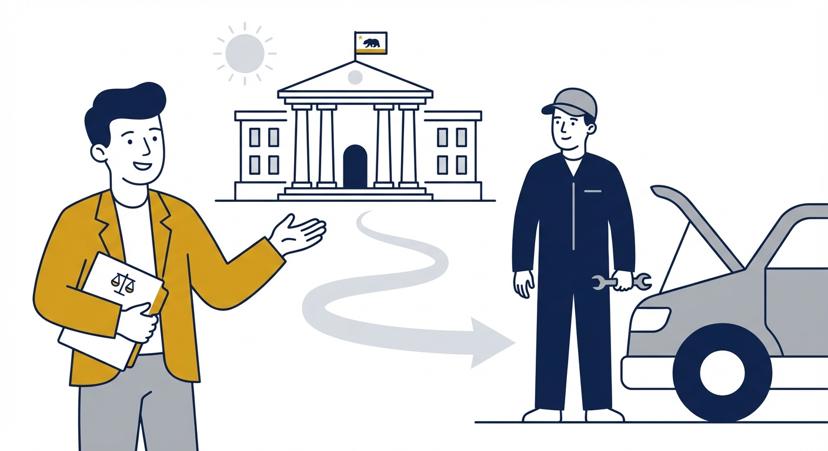
You can sue a mechanic in California for issues like unauthorized repairs, overcharging beyond an estimate, poor workmanship, deceptive pricing, unreasonable delays, warranty refusal, vehicle damage, or billing fraud. Before filing in small claims, send a document-backed demand letter and consider a Bureau of Automotive Repair (BAR) complaint to pressure a fast settlement.
Key Takeaways
- Most winning cases hinge on paperwork: written estimates, clear authorization, and itemized invoices.
- Common lawsuit triggers include unauthorized work, charges above the estimate, and negligent repairs proven by a second opinion.
- A formal demand letter with a timeline, attachments, and a specific dollar demand often resolves disputes faster than court.
- BAR complaints add leverage because shops know regulators will focus on estimate/authorization compliance.
- If settlement fails, California small claims can work well for document-driven auto repair disputes.
When a repair goes sideways, plenty of drivers immediately search how to sue a mechanic in California. That option exists, but it should be treated like the “break glass” step—not the first move. In California auto-repair disputes, the fastest path to real money back (or a real fix) usually comes from using the rules that shops must follow: written estimates, clear authorization, itemized invoices, and truthful advertising.
Below are eight common, court-worthy reasons consumers sue repair shops in California—plus the smarter pre-court playbook: a formal demand letter built around the exact documents and compliance points that regulators and judges expect to see.
What it really means to sue a mechanic in California (and why it matters)
“Suing” usually means filing a civil case, often in small claims court if the amount is within the limit. California small claims can be a fit for auto repair disputes because the facts are often document-driven: estimate, work order, invoice, texts, photos, and a second opinion.
But small claims is also the failure state. Why?
- It takes time (filing, service, hearing date).
- It requires organization and proof.
- Even after winning, collecting can still take work.
That is why consumer advocates typically recommend trying to seek a settlement first—using a formal demand letter that lays out: what happened, what rules were violated, what proof exists, and what must be done by a deadline.
Two California-specific realities make this strategy especially effective:
- California repair shops must follow strict consumer notice and authorization rules. Many disputes turn on whether the shop got proper approval and documented it.
- The Bureau of Automotive Repair (BAR) can mediate and investigate. The shop knows that a well-documented demand letter can become the backbone of a BAR complaint. The BAR’s complaint process is explained on the official site: BAR Complaint Guide.
For deeper background on the pre-court approach, see the Auto Repair Demand Letter Guide.
8 key reasons consumers sue mechanics in California (with real-world auto repair examples)
1) Unauthorized repairs (work done without clear approval)
What it looks like: A driver authorizes a diagnostic and brake inspection. The shop replaces pads/rotors and adds a brake fluid flush—then presents a bill hundreds higher than expected.
Why it’s lawsuit-worthy: California consumer-facing court guidance emphasizes that shops should not start work until the customer receives an estimate and authorizes repairs, and additional work generally requires additional authorization. Many county courts publish “automotive repair rights” summaries that highlight this estimate/authorization requirement (example: San Mateo County Courts – Automotive Repair Rights).
Proof that matters:
- The written estimate/work order
- Any signed authorization line
- Text messages or call logs showing what was (and wasn’t) approved
- The final invoice showing added line items
Mini-case: A shop quotes $420 for front brakes. The invoice is $1,050 after “recommended” add-ons. The customer never signed or text-approved the add-ons. A demand letter that highlights the missing authorization and demands removal/refund of unauthorized items often triggers a partial refund quickly—because the paperwork gap is hard to defend.
2) Charging more than the estimate without permission
What it looks like: The estimate says $900. The shop calls it “unexpected complications” and hands over a $1,600 invoice—without getting approval for the increase.
Why it’s lawsuit-worthy: In California, the estimate is not just “nice to have.” It is a compliance anchor. If the cost changes materially, the shop is expected to communicate and obtain authorization before proceeding.
Proof that matters:
- The original estimate
- Any revised estimate (or lack of one)
- Timeline: when the shop discovered the “complication” vs. when approval was requested
Practical angle: Even when extra work is legitimate, the dispute often becomes about process: “Was approval obtained before the extra work was performed?” That is a clean, judge-friendly question.
3) Poor workmanship (repairs not performed competently)
What it looks like: After a water pump replacement, the car overheats on the freeway. A second shop finds loose clamps, missing coolant, or improper bleeding.
Why it’s lawsuit-worthy: Negligent or substandard work can support a claim for damages tied to the bad repair and the cost to correct it. Legal commentary on defective mechanic work commonly frames this as a failure to meet a reasonable standard of care and a need to prove causation (the bad work caused the damage). See discussion examples in: Defective Mechanic Work Lawsuit (LegalMatch).
Proof that matters:
- A second opinion with a written teardown/inspection report
- Photos of incorrect installation
- Old parts (if available)
- Towing receipts and related costs caused by the failure
Mini-case: A shop replaces spark plugs and ignition coils. The car misfires immediately afterward. Another shop finds one coil connector broken and taped. The consumer’s strongest demand is usually: refund for the failed repair + cost to correct + towing, supported by the second shop’s written findings.
4) Misrepresentation and “bait-and-switch” pricing
What it looks like: An ad promises “$99 brake special,” but once the car is in the bay, the shop insists the deal “never applies” and pushes a $1,800 package.
Why it’s lawsuit-worthy: Misleading advertising and deceptive sales practices can create liability—especially when the consumer can show reliance (the ad brought the car in) and a predictable upsell pattern.
Proof that matters:
- Screenshot/photo of the ad
- Notes of what was promised at booking
- The estimate/invoice showing the inflated replacement package
- Any recorded shop messaging (texts/emails)
Practical angle: A demand letter should not argue feelings. It should attach the ad, quote it, and show the mismatch between the promise and the transaction documents.
5) Keeping the vehicle unreasonably long (or “hostage” behavior)
What it looks like: The shop repeatedly delays completion, won’t provide clear updates, and refuses to release the car unless the customer pays disputed charges.
Why it’s lawsuit-worthy: The legal theory depends on the facts (breach of contract, conversion-type claims, unfair practices), but the consumer leverage is often simpler: the shop’s paperwork and communication history usually looks bad when it shows endless delays, shifting stories, and no clear authorization trail.
Proof that matters:
- Written timeline of drop-off, promised completion dates, and actual status
- Texts showing “tomorrow” promises that never happen
- Storage fee threats (and whether they were disclosed up front)
Mini-case: A customer authorizes a clutch replacement. Three weeks later, the shop claims “parts delays,” but the parts were never ordered. The customer demands return of the vehicle and a refund of any deposit. A formal demand letter that sets a 72-hour release deadline often prompts action because the shop knows the paper trail will not read well to a regulator or judge.
6) Warranty refusal (shop won’t stand behind parts or labor)
What it looks like: The shop says the repair is “warrantied,” but when the same problem returns days later, the shop blames the customer or demands full payment again.
Why it’s lawsuit-worthy: Warranty disputes are common because “warranty” gets said casually at the counter, but enforcement depends on what was written on the invoice, estimate, signage, or shop policy. If the shop represented a warranty and then refuses to honor it, that can become a clean breach issue.
Proof that matters:
- Invoice language about warranty (parts/labor duration)
- Any written shop warranty policy
- Proof the same symptom returned and was reported promptly
Important nuance: A demand letter works best when it demands a specific outcome: re-do the work at no cost or refund labor (and sometimes parts) so the consumer can repair elsewhere.
7) Damage to the vehicle while in the shop’s care
What it looks like: The car is returned with new dents, curb rash, torn seats, missing trim, or the classic “mystery smell” after service (for example, strong smoke/weed odor that was not present at drop-off).
Why it’s lawsuit-worthy: When a vehicle is in the shop’s custody, damage that appears during that time becomes a serious liability risk for the business—especially if the consumer documented the condition at drop-off.
Proof that matters:
- Time-stamped photos/video at drop-off and pick-up
- Walkaround inspection notes (if any)
- Witness statements (friend who dropped off/picked up)
- Detailer or body shop estimate for repair/cleaning
Mini-case: A customer drops off a clean interior for a timing belt job. Pick-up reveals a strong odor and ash-like debris. The shop denies it. The consumer obtains a professional detailing estimate and includes it in a demand letter with before/after photos. Shops often settle these quickly because the cost is low compared to reputational/regulatory risk.
8) Billing fraud red flags (phantom parts, inflated labor, or “didn’t do the work”)
What it looks like:
- Invoice lists new parts, but old parts appear unchanged.
- Labor hours far exceed standard time without explanation.
- “Flushes” and add-ons billed with no evidence they were performed.
Why it’s lawsuit-worthy: Fraud allegations require care—consumers should stick to provable facts. The strongest version is not “fraud” as a label, but “the invoice claims X; inspection shows X likely did not occur.”
Proof that matters:
- Request for replaced parts back (if available)
- Photos of installed parts (part numbers/condition)
- Second-shop inspection notes
- OBD scan logs, alignment printouts, or other output that should exist if a service was performed
Practical angle: A formal demand letter should ask for documentation: part numbers, sublet invoices, technician notes, and any test results. If the shop cannot produce basic backup, settlement becomes more likely.
What most people miss (and why DIY templates often fail)
Most consumers lose leverage because the dispute is argued like a conversation instead of a record.
Common mistakes:
- No timeline. A judge, regulator, or shop owner needs dates: drop-off, estimate, approvals, completion promises, breakdowns.
- No document stack. The winning disputes attach the estimate, invoice, photos, and the second opinion.
- Vague demands. “Make it right” is not a demand. “Refund $742 for unauthorized repairs by Friday at 5pm” is.
- Threatening court too early. Empty threats reduce credibility. A better approach is a calm, documented notice that the consumer is prepared to escalate if the deadline passes.
- Skipping BAR leverage. The Bureau of Automotive Repair exists specifically for this category of dispute and can mediate/investigate when a shop will not resolve issues directly: BAR Complaint Guide. A shop that ignores a well-supported demand letter knows the next step can be a BAR complaint.
For a focused comparison of escalation options, see Bar Complaint Vs Demand Letter.
The superior way: a formal demand letter built around California auto-repair rules (before court)
A strong demand letter is not a rant. It is a settlement tool that makes the shop’s risk obvious and the path to resolution simple.
DemandDraft’s approach automatically turns the consumer’s story into a structured, evidence-backed demand that mirrors how disputes are evaluated: authorization, estimate compliance, invoice accuracy, workmanship proof, and measurable damages. We do this for you automatically. Instead of a generic template, the letter is built from the specific transaction facts (dates, amounts, documents, and the exact outcome requested).
That mechanism matters because auto repair disputes are rarely won by emotion. They are won by:
- clear documents,
- clear rule violations (estimate/authorization),
- clear proof of damages (second opinion + receipts),
- and a deadline with a specific settlement offer.
What to include in a California mechanic demand letter
- Parties and vehicle details: shop legal name, address, repair order number, VIN/plate.
- Timeline: drop-off date, estimate date, authorization method, pick-up date, failure date.
- The dispute issue(s): unauthorized work, over-estimate charges, poor workmanship, damage, warranty refusal.
- Proof list (attachments): estimate, invoice, photos, texts, second opinion, towing receipts.
- Demand: refund amount and/or rework terms, plus reimbursement for related costs.
- Deadline and next steps: a reasonable deadline (often 7–10 days) and escalation path (BAR complaint + small claims if needed).
For a practical checklist, use Formal Demand Letter Checklist. If the shop already stopped responding, see Mechanic Ignored Demand Letter California.
When small claims becomes necessary
If the shop refuses to resolve after a proper demand, small claims may be the next step. California small claims has a dollar cap and process rules that matter. For a dedicated walkthrough, see Sue Mechanic Small Claims California.
(Also note: small claims procedure and attorney participation rules vary by state. For example, California small claims generally limits lawyer participation at the hearing, while states like Texas and Florida have different small-claims procedures and representation norms depending on the court and case type. Always confirm local court rules before relying on assumptions.)
Start the resolution process today (before court becomes the only option)
A consumer does not need to accept unauthorized charges, sloppy repairs, or a vehicle returned in worse condition. The fastest path is usually a formal demand letter that uses the shop’s required paperwork—estimate, authorization, and invoice—to prompt a real decision.
Start your demand letter to start the resolution process today.
Start your letter now
Frequently Asked Questions
What are the main reasons to sue a mechanic in California?
Common reasons include unauthorized repairs, charging more than the estimate without approval, poor workmanship, misleading ads or bait-and-switch pricing, unreasonable delays or refusing to release the car, warranty refusal, damage while in the shop’s care, and billing red flags like phantom parts or inflated labor.
What evidence do I need before suing a mechanic in California?
Bring the written estimate/work order, proof of authorization (signature, texts, emails, call notes), the final itemized invoice, photos/videos, and a second shop’s written inspection report. Add receipts for towing, rentals, diagnostics, and any repair-to-correct costs.
Should I send a demand letter before small claims court?
Yes. A demand letter that lays out the timeline, the rule/process failure (estimate/authorization), your attachments, and a specific refund or rework demand with a deadline often triggers settlement—saving time and improving your position if you later file.
Can the California Bureau of Automotive Repair (BAR) help with my dispute?
Often, yes. BAR can take complaints, mediate, and investigate repair shops. A well-documented demand letter can double as the backbone of a BAR complaint, which increases pressure on the shop to resolve the issue.
When is California small claims court the right move against a mechanic?
Use small claims when the shop won’t settle after a clear demand letter and you have strong documents showing unauthorized work, estimate overages without approval, or provable damages (like a second opinion and receipts). Be prepared to organize evidence and handle collection if you win.