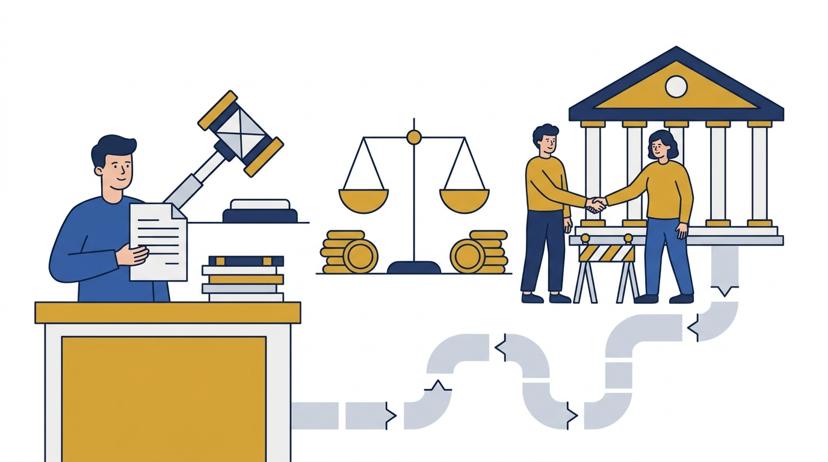
In Missouri, the small claims court limit is $5,000. This division handles cases involving money damages, such as auto repair disputes. However, many consumers can resolve these issues without a trial by sending a formal demand letter citing the Missouri Merchandising Practices Act (MMPA) and RSMo Section 407.020.
Key Takeaways
- The Missouri small claims court limit is strictly capped at $5,000 for money damages.
- The Missouri Merchandising Practices Act (MMPA) protects consumers from unauthorized repairs and hidden fees.
- A formal demand letter citing specific Missouri statutes is often more effective than filing a lawsuit.
- Shops are legally required to provide estimates and cannot perform work without customer authorization.
Vehicle owners in Missouri often find themselves in a vulnerable position when a mechanic provides a bill that far exceeds the original estimate. The frustration of paying for repairs that did not fix the problem, or discovering that a shop performed unauthorized work, creates a significant financial burden. Many consumers believe their only recourse is to file a lawsuit, but the small claims court limit missouri presents a specific boundary for these disputes. In Missouri, the small claims division is restricted to cases where the amount in controversy does not exceed $5,000.
While $5,000 covers many common repair issues, it often fails to account for major engine replacements, transmission overhauls, or the total loss of a vehicle due to shop negligence. When a dispute arises, the immediate instinct is to "see them in court." However, trials are slow, expensive, and often unnecessary. The real power lies in resolving the conflict before a judge ever sees the file. By understanding the rules governing estimates, invoices, and authorizations, a consumer can often seek a settlement by demonstrating that the shop violated state consumer protection standards.
The Hidden Financial Strain of Missouri Auto Repair Disputes
Vehicle owners in Missouri often find themselves in a vulnerable position when a mechanic provides a bill that far exceeds the original estimate. The frustration of paying for repairs that did not fix the problem, or discovering that a shop performed unauthorized work, creates a significant financial burden. Many consumers believe their only recourse is to file a lawsuit, but the small claims court limit missouri presents a specific boundary for these disputes. In Missouri, the small claims division is restricted to cases where the amount in controversy does not exceed $5,000.
Navigating the Small Claims Court Limit Missouri: Why Templates Often Fail
When an auto repair dispute crosses the $5,000 threshold, the consumer is forced into the regular Circuit Court. This environment is significantly more complex and typically requires more formal procedures. Even if the claim is under the small claims court limit missouri, the process is far from instantaneous. According to the Missouri Small Claims Court Handbook, the court can only handle claims for money and cannot order a shop to actually fix the car or return parts.
Many consumers attempt to resolve these issues by downloading generic demand letter templates found online. These templates usually fail for three specific reasons:
- Lack of Specificity: A generic letter might mention "unfair treatment," but it rarely cites the specific Missouri regulations that a shop owner actually fears.
- No Legal Teeth: Without referencing the Missouri Merchandising Practices Act (MMPA), a demand letter looks like a standard complaint that a shop manager can easily ignore.
- The "Bluff" Factor: Shops deal with angry customers daily. They are trained to ignore noise. They only respond to documented proof of a violation that could lead to a court awarding punitive damages or attorney’s fees.
Trials are a failure of the negotiation process. If a case reaches a courtroom, both parties have already lost time and money. The goal is to make the shop understand that settling the dispute now is significantly cheaper than defending their actions in court later. This is especially true in Missouri, where certain violations allow a court to award more than just the original repair cost.
Leveraging the Missouri Merchandising Practices Act (MMPA)
Missouri does not have a standalone "Auto Repair Act" like some other states. Instead, auto repair disputes are governed by the Missouri Merchandising Practices Act (MMPA), specifically RSMo Section 407.020. This law prohibits "unfair practices," which are defined as actions that offend public policy or are unethical, oppressive, or unscrupulous.
Under the MMPA and the accompanying regulation 15 CSR 60-8.020, several common mechanic behaviors are classified as unlawful. For example, beginning repairs and billing a customer without first providing a written estimate of labor and parts is considered an unfair practice. If a consumer suffers an "ascertainable loss" due to this lack of an estimate, they may seek a private remedy under RSMo Section 407.025.
Consider a scenario where a driver in Springfield takes their truck in for a simple oil leak. The shop, without calling for authorization, decides to replace the entire cooling system and presents a bill for $2,400. Because the shop performed repairs without the customer's authorization, they have committed an unfair practice under RSMo 407.020. In this instance, the consumer does not need to prove the shop intended to commit fraud; the act of charging for unauthorized work is enough to trigger the law.
Another frequent issue involves shops that charge for parts not installed. If a shop bills for a brand-new OEM (Original Equipment Manufacturer) alternator but installs a used part from a salvage yard, this is a direct misrepresentation under the MMPA. The consumer is entitled to the "benefit-of-the-bargain," meaning the difference in value between what was paid for and what was actually received.
The Strategic Mechanism: Resolving Disputes Without a Judge
The most effective way to handle a dishonest or incompetent shop is not to wait for a court date, but to send a formal demand letter that utilizes the framework of Missouri law. This is the mechanism DemandDraft provides. Instead of a vague emotional plea, the platform generates a professional demand that cites specific Missouri statutes.
When a shop receives a letter citing RSMo 407.020 and mentions the potential for punitive damages and attorney’s fees under RSMo 407.025, the calculation changes for the business owner. They are no longer just dealing with an unhappy customer; they are dealing with a documented legal risk.
Case Study: The Unauthorized Transmission Overhaul
A consumer in Kansas City authorized a $150 diagnostic fee for a slipping transmission. Two days later, the shop called to say the car was ready and demanded $3,800 for a full rebuild. The consumer never signed a work order or an estimate for that amount. By sending a formal demand letter citing the "unfair practice" of performing unauthorized repairs under the MMPA, the consumer was able to negotiate the bill down to the cost of parts only, saving over $2,000 without ever stepping into a courthouse.
Case Study: The Hostage Vehicle
In St. Louis, a shop refused to release a vehicle because the owner disputed a $600 "storage fee" that was never disclosed in the original agreement. Holding a vehicle hostage to coerce payment of improper charges is considered an oppressive practice under Missouri law. A formal demand letter pointed out that while a shop may have a mechanic's lien for proper charges, using that lien to extract payment for undisclosed fees exceeds their legal rights. The shop waived the fees within 24 hours of receiving the notice.
Strategic Application of Missouri Consumer Law
To successfully resolve an auto repair dispute, the consumer must maintain a clear paper trail. This documentation is the "proof" required to make a demand letter effective.
- The Written Estimate: Always ask if the shop provides a written estimate before work begins. If they refuse, it is a red flag. If they proceed without one and then overcharge, they are in violation of Auto Repair Laws.
- Authorization Logs: Keep a record of every phone call. Note the time, the name of the person spoken to, and exactly what was authorized. If the final bill exceeds the authorized amount materially, the shop has committed an unfair practice under RSMo 407.020.
- Itemized Invoices: Missouri law requires that consumers be able to verify charges. If a shop fails to provide an itemized invoice or documentation for services performed, it obstructs the consumer's rights. This failure to document the work is actionable under the MMPA.
- Return of Replaced Parts: While Missouri does not have a specific statute requiring the return of parts, refusing to return them—especially when requested at the time of the work order—can be viewed as an unfair practice if it conceals whether the parts were actually defective.
If the repair work itself was defective—meaning the consumer paid for a fix but the car still doesn't run—this is a breach of the "benefit-of-the-bargain." Under Auto Repair Laws Demand Letter strategies, the consumer should demand a refund of the labor costs or the amount required to have the job finished correctly by a different shop.
Why DemandDraft is the Superior Choice
The traditional path of hiring an attorney for a $3,000 or $4,000 dispute is often not cost-effective. Many attorneys will charge a retainer that exceeds the value of the claim itself. Conversely, filing in small claims court requires the consumer to take time off work, pay filing fees, and navigate the service of process, all while staying under the small claims court limit missouri.
DemandDraft offers a middle ground. It provides a formal demand letter without the high cost of a law firm. By using the platform to generate a notice that cites Missouri-specific statutes like RSMo 407.020, the consumer signals to the shop that they understand their rights. This approach shifts the power dynamic. The shop realizes that the consumer has the tools to escalate the matter to the Attorney General or a private lawsuit where attorney's fees could be awarded.
Most shops would rather settle a dispute for a few hundred or a few thousand dollars than risk a judgment that includes punitive damages. The goal is a professional, firm, and legally grounded communication that pushes the shop to the table.
Taking the First Step Toward Resolution
Disputes with mechanics do not have to end in a long, drawn-out court battle. By focusing on the specific violations of the Missouri Merchandising Practices Act, consumers can often achieve a fair result through a formal demand. Whether the issue is unauthorized repairs, a failure to provide an estimate, or poor workmanship that left the vehicle in worse condition, the law provides a pathway for recovery.
Do not let a shop hold your vehicle or your finances hostage. By applying the correct legal pressure, you can move past the frustration and get back on the road.
Start your demand letter to start the resolution process today. Start your letter now.
Frequently Asked Questions
What is the small claims court limit in Missouri?
The maximum amount you can sue for in Missouri small claims court is $5,000.
Can a Missouri small claims court order a mechanic to fix my car?
No, the small claims division in Missouri can only award money damages; it cannot order specific performance like car repairs.
What law protects Missouri consumers from bad mechanics?
The Missouri Merchandising Practices Act (MMPA), specifically RSMo Section 407.020, prohibits unfair and deceptive practices in auto repairs.
Do I need a lawyer for small claims court in Missouri?
No, small claims court is designed for individuals to represent themselves without the high cost of an attorney.
What happens if my repair dispute is over $5,000?
If your claim exceeds the $5,000 limit, you must file in the regular Circuit Court, which involves more complex legal procedures.