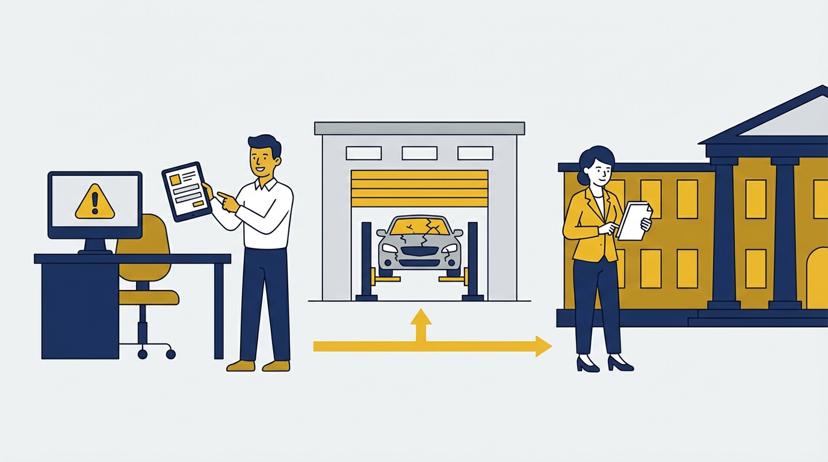
To file a Bureau of Automotive Repair (BAR) complaint in California, gather your written estimate, final invoice, and proof of payment. Submit your claim through the official BAR website. While the BAR mediates disputes and investigates licensing violations, they cannot force a shop to pay you; a formal demand letter is often required for a refund.
Key Takeaways
- Gather all documentation, including the initial written estimate and final invoice, before filing.
- Submit your complaint online via the BAR website to initiate state-level mediation.
- Understand that the BAR acts as a neutral mediator and cannot legally force a shop to issue a refund.
- Use a formal demand letter alongside your complaint to create the legal pressure necessary for a settlement.
- BAR inspection reports can serve as powerful evidence if you eventually need to go to small claims court.
When a mechanic fails to perform a job correctly or charges for work that was never authorized, the frustration can be overwhelming. In California, the primary state agency tasked with overseeing these disputes is the Bureau of Automotive Repair (BAR). Filing a bureau of automotive repair complaint is a formal way to alert the state that a shop has potentially violated the Automotive Repair Act.
The BAR serves as a regulatory body that licenses and regulates approximately 36,000 automotive repair dealers across California. Each year, the agency mediates roughly 18,000 consumer complaints. The goal of this process is to act as a neutral third party to find a resolution between the car owner and the shop.
This process matters because it creates a paper trail. If a shop has a history of predatory behavior, the BAR can take disciplinary action against their license. For the individual consumer, the BAR can often facilitate a "goodwill" adjustment or a refund by pointing out where the shop failed to follow state-mandated procedures. However, it is important to understand that the BAR is a mediator, not a judge. They cannot force a shop to pay money; they can only suggest it based on their findings.
What is a Bureau of Automotive Repair Complaint and Why it Matters?
Navigating the state bureaucracy requires precision. A poorly documented complaint is easily dismissed by a shop’s management. To ensure a bureau of automotive repair complaint carries weight, follow these specific steps:
Step-by-Step Execution for a Bureau of Automotive Repair Complaint
1. Gather Documentation
The strength of a complaint lies in the "proof," not just the story. Before visiting the BAR website, collect every piece of paper related to the transaction. This includes:
- The Initial Estimate: California law requires a written estimate before any work begins.
- The Final Invoice: This must show the final price, the parts used (and whether they were new, used, or rebuilt), and the labor performed.
- Proof of Payment: Credit card statements or cleared checks.
- Photos or Video: If the dispute involves poor workmanship (e.g., a "weed smell" left in the car or a bumper that was not aligned), visual evidence is critical.
2. Submit the Formal Complaint
The BAR provides an online complaint form for ease of use. Alternatively, consumers can mail a physical form to their headquarters in Rancho Cordova. The description of the problem should be objective. Instead of saying "The mechanic was mean and a liar," state "The mechanic charged $500 for a radiator replacement that was not included in the original written estimate, violating Business and Professions Code § 9884.9."
3. The Mediation Phase
Once the complaint is assigned to a BAR representative, they will contact the shop. The representative will review the shop’s records to see if they followed the "Write It Right" guidelines provided by the state. If the shop failed to get a signature for additional work, the BAR representative will point this out to the shop owner. This often leads to the shop offering a partial or full refund to avoid further state scrutiny.
4. Inspection (If Necessary)
In cases of mechanical failure or poor bodywork, the BAR may conduct a field inspection. A state investigator will physically look at the vehicle to determine if the repairs were performed according to industry standards. This inspection report is a powerful document that can be used later if the dispute escalates.
Common Pitfalls: Why Most Complaints Fail to Get Results
Many consumers file a complaint and expect a check to arrive in the mail the following week. This rarely happens. Understanding the limitations of the BAR is essential to managing expectations.
The "Neutrality" Trap
The BAR is a neutral mediator. They do not "represent" the consumer. Their job is to ensure the shop followed the law. If the shop followed all the rules but the car still has issues, the BAR may find "no violation," leaving the consumer with no leverage. Relying solely on a state agency often leads to a stalemate where the shop simply refuses to cooperate, knowing the BAR lacks the power to seize funds.
Lack of Legal Leverage
A common mistake is treating the BAR complaint as the final step. Shops often treat these complaints as a cost of doing business. They may give the BAR representative a "polite no," and the case is closed. Without a formal demand for payment that outlines the specific intent to pursue further action, the shop has little incentive to settle. Consumers often find themselves stuck in a loop of mediation that results in no actual recovery of funds.
Missing the "First Step"
Many people jump straight to the BAR without first attempting a formal resolution. This is often a tactical error. In many cases, a Bar Complaint Vs Demand Letter analysis shows that a direct, professional demand for payment is more effective at getting a shop’s attention than a government form that might sit on a desk for weeks.
The Superior Way: Using a Demand Letter to Seek a Resolution
While the BAR is a useful tool for documentation, the most effective way to resolve an auto repair dispute is to treat the situation with the professional gravity it deserves. Trials are slow, expensive, and often unnecessary. The goal should be to fix the problem before it ever reaches a courtroom.
The Power of the Formal Demand
A formal demand letter serves as a "notice of intent." It signals to the shop that the consumer is organized, knows the law, and is prepared to take the next step. By citing specific rules—such as the written-estimate requirement or the ban on unauthorized repairs—the consumer puts the shop on the defensive.
When a shop receives a professional demand letter, their risk assessment changes. They are no longer just dealing with an "unhappy customer"; they are dealing with a potential legal liability that could cost them thousands in court fees and damages. This is where tailored demand letters differ from generic complaints.
How DemandDraft Changes the Dynamic
The mechanism behind a successful resolution is the application of legal pressure through structured communication. DemandDraft provides a platform that helps consumers generate these high-stakes documents without the need for an expensive attorney.
By using the platform, consumers can:
- Cite the Law: The letter can cite state consumer protection laws (e.g., California's Automotive Repair Act).
- Professional Presentation: A letter generated through the platform looks and feels like a legal document, which commands more respect than a handwritten note or an angry email.
- Create a Deadline: Every demand letter includes a specific timeframe for a response. This asks the shop to respond by a set date.
Case Study: The Unauthorized Transmission Repair
Consider a scenario in California where a shop was authorized to perform a $200 fluid flush but instead replaced the entire transmission for $3,500 without calling the owner. A BAR complaint might eventually lead to a warning for the shop. However, a formal demand letter citing California Business and Professions Code § 9884.9 (which prohibits charging for work in excess of the estimate without consent) provides the shop with a clear choice: refund the unauthorized $3,300 now or explain the violation to a judge. Most shops, when faced with clear evidence of their own rule-breaking, will choose to settle.
Case Study: The "No-Fix" Diagnostic
In Florida, a consumer paid a mechanic $1,200 to fix a stalling engine. The car stalled again three blocks away. The mechanic refused to refund the money, claiming they "did the work." By using a formal demand letter checklist, the consumer was able to document the failure of the "repair" and demand a refund based on the failure of consideration. The professional nature of the demand led the shop to offer a 75% refund within 48 hours to avoid a public dispute.
Moving Beyond the "Failure State"
Small claims court should be viewed as the failure state of a dispute. It is the outcome that occurs when communication and negotiation have broken down completely. To avoid this, consumers must use the rules of the industry to their advantage. Whether it is an issue of unauthorized charges or poor workmanship, a demand letter is the tool that pushes a shop to take the consumer seriously.
By combining a bureau of automotive repair complaint with a professional demand letter, consumers create a two-pronged attack. The BAR complaint puts the shop's license at risk, while the demand letter puts their bank account at risk. This combination is the most effective way to secure a refund and resolve the dispute once and for all.
Start your demand letter to start the resolution process today. Start your letter now.
Frequently Asked Questions
Can the Bureau of Automotive Repair force a mechanic to refund me?
No, the BAR acts as a mediator rather than a judge. While they can suggest a refund or 'goodwill' adjustment, they lack the legal authority to force a shop to pay you.
What documents do I need for a BAR complaint?
You should provide the initial written estimate, the final invoice, proof of payment (like a credit card statement), and any photos or videos of the poor workmanship.
How long does the BAR complaint process take?
Once submitted, a BAR representative is typically assigned to the case within a few weeks to review records and contact the automotive repair dealer for mediation.
Is there a cost to file a complaint with the BAR?
No, filing a complaint with the Bureau of Automotive Repair is a free service provided to California consumers to help regulate the auto repair industry.
What is the difference between a BAR complaint and a demand letter?
A BAR complaint alerts the state to licensing violations and starts mediation, while a demand letter is a formal legal notice that threatens a lawsuit if the shop doesn't pay.