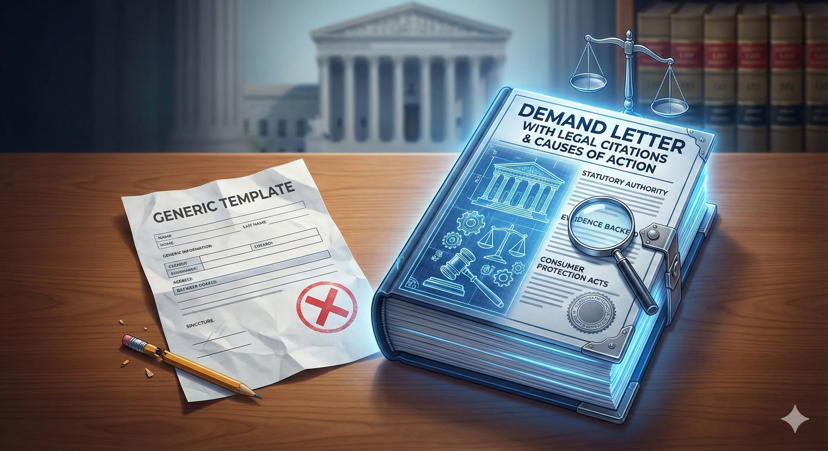
Tailored demand letters featuring legal citations and specific causes of action are significantly more effective than generic templates in resolving auto repair disputes. These professional documents provide a clear legal roadmap for small claims judges and signal to repair shops that the claimant is prepared for litigation.
Key Takeaways
- Tailored demand letters with legal citations carry more weight than generic templates by demonstrating a claimant's readiness for litigation.
- Including specific causes of action, such as breach of contract or negligence, forces repair shops to take disputes more seriously and increases settlement probability.
- Providing a clear legal framework helps overworked small claims commissioners and judges make faster, more informed decisions on a case.
- Professional demand letters that cite consumer protection or safety statutes signal that a dispute is factually credible and legally enforceable.
- A well-documented demand letter serves as a documented good-faith effort to resolve a dispute and can potentially lead to triple damages if the merchant fails to respond.
Why a demand letter with legal citations and causes of action is superior to generic demand letter templates
Estimated reading time: 11 min
- A properly constructed demand letter with legal citations and causes of action carries significantly more weight than generic templates.
- Legal citations equip small claims commissioners with clear legal authority, helping expedite and clarify case decisions.
- Auto repair disputes often involve consumer protection, health, and safety statutes that add legal leverage.
- Clearly stating causes of action reduces counterclaims and makes the legal stakes explicit.
- Professional tone and detailed evidence presentation increase credibility and settlement probability.
Generic demand letter templates may look polished, but they often miss the legal punch required to unsettle an auto repair shop, persuade a judge, or compel a decision-maker to take your complaint seriously. The topic of this post is that a demand letter fortified with precise legal citations and clearly articulated causes of action significantly outperforms canned templates. In high-volume small claims settings—especially automotive disputes involving costly repairs, ill-fitting diagnostics, or lingering safety concerns—decision-makers are already daunted by caseload pressure. A demand letter that mirrors the rigor of a complaint and arrives with the legal scaffolding expected in a formal filing not only signals credibility but also materially increases the chances of a favorable outcome without stepping into filing fees, court appearances, or drawn-out appeals.
This is especially true in auto repair disputes where the damage often extends beyond the monetary contract to include health, safety, and statutory consumer protections. Generic templates may provide a place to input dollar amounts and dates, but without legal grounding, they leave judges, small claims commissioners, and the opposing shop wondering whether the claimant is ready for the actual facts of the law. By contrast, an evidence-backed letter that refers to relevant statutes, trench-tested causes of action, and the consumer’s hard losses can shortcut confusion, force the auto shop to take the dispute seriously, and give overloaded decision-makers the context they need to issue a reasoned award.
Demand letters that behave like legal briefs, not retirement cards
The stark difference between a boilerplate demand and a demand that mirrors a lawyer-prepared brief is the presence of legal research and context. Law firms that specialize in demand letters often emphasize this point: the letter should set up the facts, cite the applicable legal framework, and warn of imminent legal remedies in a professional tone that conveys the sender is litigation-ready. Templates circulate widely, but they rarely encourage or even allow clients to cite the exact statutory provisions or causes of action on which their claims rest, and they do nothing to explain to the recipient why those provisions apply to a very specific auto repair dispute.
Real demand letters drafted with legal citations, however, accomplish several things at once: they document a good-faith effort to resolve the dispute, they frame the auto shop’s conduct within the confines of recognized law, and they demonstrate that the claimant understands not only what happened but why it is legally actionable. Legal professionals know that a vigorously researched, strongly worded demand often prevents a lawsuit altogether because the opposing party recognizes the effort and the risk of a full case—98% of civil cases settle before trial, and small claims is no exception. Real demand letters drafted with legal citations A demand letter that settles for “please fix it” will rarely carry the same weight as the one that outlines breach of contract, negligence, and fraud or deceptive practices with citations to specific statutes or regulations.
Moreover, a legal demand letter’s tone and structure encourage the recipient to pause and consult their own counsel rather than dismiss the communication as a nuisance. When the letter arrives with references to state consumer protection acts, automotive safety statutes, or the Magnuson-Moss Warranty Act, it becomes clear the claimant is prepared to go further. To an auto repair shop used to receiving generic complaints, this shift in depth from form to substance signals that the dispute is factually credible and legally enforceable, nudging them toward resolution instead of defensive stonewalling.
Legal citations equip small claims commissioners with the tools they need
Small claims commissioners and judges often have limited time, rotating dockets, and no specialism in automotive law. They rely heavily on whatever information the parties supply at the outset to shape their understanding because they cannot dig through the statute books for every case. When a demand letter arrives with a clear recitation of the applicable legal authority and how it connects to the auto shop’s conduct, it gives the commissioner a roadmap to the legal question they are being asked to answer. Judges do not want to guess why the damages number is what it is, and the law expressly requires plaintiffs to be ready to explain their calculations and the basis for their claim. Law expressly requires plaintiffs to be ready to explain their calculations and the basis for their claim
A demand letter that furnishes those explanations up front can drastically improve how the commissioner views the case when it eventually lands on the calendar. If the dispute is something the commissioner can resolve without a full hearing—because the demand letter explains the violation, sets forth supporting statutes, and attaches evidence—the judge can issue a faster decision, reducing court caseloads and avoiding the need for follow-up and appeals. In fact, one court resources page notes that when the merchant fails to respond in good faith to a demand, the court can award triple damages and the case is more likely to be resolved on the papers, saving time for everyone involved. Demand letter failure to respond can lead to triple damages
This efficiency matters. Demand letters that reduce case load give overworked small claims commissioners the justification they need to do more with less. When the opposition sees that the claimant’s demand letter includes legal citations, the shop is more likely to believe that a commissioner has already been briefed, and that the claimant has effectively “filed half a case” already. That perception alone can prompt the shop to settle, as they worry the claimant has effectively already “hired a lawyer,” even if the claimant is self-represented. Demand letter perceptions influence settlement By contrast, a generic template leaves both the opposition and the court guessing about the legal theory behind the money demand, which invites extra exchanges, delays, and potentially appeals that are expensive for all sides. Generic demand letters invite delays and appeals
Automotive, health, and safety statutes give the letter teeth
Auto repair disputes are not just about money—they often involve safety risks and the violation of specific statutes meant to protect consumers. The thorough demand letter should therefore cite the statutory authority that governs the auto shop’s obligations. For example, in California, a demand letter is sometimes mandatory under the Consumer Legal Remedies Act (CLRA) before filing suit for certain unfair or deceptive practices, and the letter should explicitly describe the conduct, invoke the CLRA, and demand a remedy within the statutory settlement window. CLRA demand letter requirements Similarly, the Massachusetts Consumer Protection Act and the accompanying 30-day demand letter requirement demand that claimants outline unfair or deceptive practices with detail, including the relevant regulation numbers if known, and explain the resulting harm. Massachusetts demand letter requirements This is not theoretical—these statutes confer the ability to seek treble damages and attorney’s fees, which adds significant leverage, particularly when combined with references to health-related or safety-related harm. Statutes confer treble damages and attorney’s fees
A well-prepared demand letter will also signal the claimant’s awareness of the shop’s repair order obligations, guarantees, teardown estimates, and safety protocols. For example, California’s automotive repair guidance states that tear-down estimates must specify reassembly costs and timelines, the shop must document increases in estimated prices, and any guarantees must follow specified elements. California automotive repair guidance Including those references in a demand letter shows the judge that the claimant is not simply angry about poor service—they understand which duties exist under the law and how the shop violated them.
Demand letters that focus on compliance with these laws emphasize health and safety, not just dollars, helping the claimant connect the facts of a faulty repair to the statutes that regulate automotive repairs. When a demand letter quotes the Magnuson-Moss Warranty Act or a state-specific automotive repair law, it adds a layer of federal and statewide scrutiny that insurance companies and repair shops are loathe to ignore. Legal context adds scrutiny and enforcement weight This type of legal context also gives the commissioner the framework they need to rule in the claimant’s favor and underscores that the claimant is similarly informed about further remedies if the response is insufficient.
Causes of action clarify the legal stakes and keep the auto shop honest
Demand letters are much stronger when they explicitly state the causes of action the claimant would bring if the dispute remains unresolved. In auto repair disputes, common actionable theories include breach of contract (the shop failed to perform as promised in the work order), negligence (the mechanic failed to exercise the care of a reasonably competent professional), and fraud or deceptive practices (charging for work not performed). Common causes of action in auto repair disputes Stating those causes of action and tying them to specific facts and statutes changes the conversation from “you did a bad job” to “you breached binding obligations, and I have evidence to prove it.”
Additionally, acknowledging and calibrating these causes of action helps avoid counterclaims. When a demand letter offers evidence-based claims while respecting the opposing party’s obligations, the recipient has no easy path to allege harassment or bad faith. Avoiding counterclaims with clear causes of action In other words, clear causes of action keep the interaction professional and focused on the legal elements rather than emotional statements that could prompt defensive reactions.
Outlining these causes of action also provides the judge with the precise legal standard they would apply, making the commissioner more comfortable awarding damages. Judges prefer clarity, and a demand letter that carefully walks through the applicable breach, negligence, and fraud theories, while referencing relevant statutes, creates a compelling record that the court can rely on even if the case ultimately proceeds to a hearing. Clarity in causes of action benefits the court
Professional tone, polished evidence, and AI-grade legal research
Demand letters for auto repair disputes must maintain the same professionalism expected in court. Courts expect clarity, conciseness, and a tone free of derogatory remarks, which means claimants should carefully proofread and streamline their letters before sending them to the shop or the court clerk. Importance of professional tone in demand letters Words matter because judges and commissioners may read the demand letter before a hearing, and sloppy or emotional language dilutes the letter’s perceived seriousness.
The goal is to present the facts clearly, label exhibits, and describe the legal theory—not to vent about the shop’s shortcomings. Even when the claimant lacks a law degree, writing the demand letter with “an eye to a judge” helps show the court that the claimant is prepared, organized, and grateful for the chance to resolve the dispute fairly. Writing with “an eye to a judge” Evidence such as repair orders, correspondence, estimates, and photos should be summarized in the demand letter and referenced in an exhibit list, showing the decision-maker that all documentary proof is already in place.
An AI-powered demand letter service can accelerate this process by analyzing the dispute, identifying the relevant statutes and causes of action, and drafting a compelling letter with citations and exhibits already referenced. This ensures the opposition and the court see a document that reads like it was drafted by someone who researched the law, which is precisely what overworked small claims commissioners need to rule in the claimant’s favor. The same legal rigor that law firms deliver with expensive hours can now be reproduced faster and more affordably. AI-powered demand letter services The result: the auto shop takes the claim seriously, the court receives an informed explanation, and the claimant is better positioned to secure a favorable award without having to file a formal complaint.
Demand letters equipped with statutes, case law, and clearly articulated causes of action also reduce the likelihood of the case spiraling into appeals. When every corner of the claim is documented and tied to law, the judge has less reason to remand or send the matter to a higher court, and the claimant avoids the cost and delay of additional filings. Reduced appeals with well-documented demand letters AI-assisted drafting makes this process repeatable and consistent, ensuring every letter produced by a consumer-focused legal partner meets the evidentiary and stylistic expectations of small claims tribunals.
Call to Action
Ready to submit a demand letter that courts, commissioners, and auto repair shops take seriously? Let our AI-powered consumer legal demand letter service do the heavy lifting—every letter we produce comes with the relevant automotive, health, safety, and consumer protection citations plus tailored causes of action that align with your dispute. Contact us today to start with a letter that feels litigated, even before a filing is made.
Frequently Asked Questions
Why is a tailored demand letter better than a generic template?
Tailored letters include specific legal citations and causes of action that signal credibility to the shop and provide a clear roadmap for a judge to follow.
What legal theories should be included in an auto repair demand letter?
Effective letters often cite breach of contract, negligence, fraud, or violations of state consumer protection and automotive safety statutes.
How does a professional demand letter affect small claims court proceedings?
It helps judges understand the legal basis of the claim quickly, which can expedite the decision-making process and reduce the need for follow-up hearings.
Can a demand letter help settle a case without going to court?
Yes, a rigorous demand letter often prompts shops to settle because it demonstrates the claimant's legal knowledge and readiness to proceed with a full case.