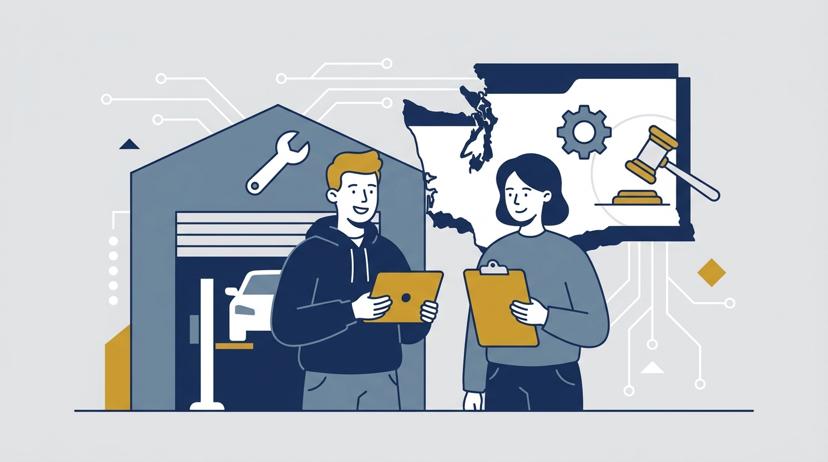
Auto repair laws in Washington, specifically the Automotive Repair Act (RCW 46.71), protect consumers by requiring written estimates for repairs over $100. Shops cannot charge more than 110% of the authorized amount without additional consent. Violations are considered unfair trade practices, allowing consumers to seek damages and attorney fees under the Consumer Protection Act.
Key Takeaways
- The Washington Automotive Repair Act (ARA) requires written estimates for any work exceeding $100.
- Mechanics are legally barred from charging more than 110% of the original authorized estimate.
- Violating the ARA is a per se violation of the Washington Consumer Protection Act, which may allow for triple damages.
- Consumers have the legal right to request their replaced parts back at the time of authorization.
- A formal demand letter citing specific RCW codes is often more effective than jumping straight to small claims court.
Car repairs are often stressful, but the stress compounds when a mechanic provides a bill far higher than expected or performs work that was never requested. Fortunately, auto repair laws in Washington provide some of the strongest consumer protections in the country. These regulations, primarily found in the Washington Automotive Repair Act (ARA), set strict requirements for how shops must provide estimates, obtain authorization, and document their work.
Understanding these rules is the first step in moving from a position of frustration to a position of power. When a repair facility ignores these statutes, they often lose the legal right to collect payment for the disputed work. Rather than viewing small claims court as the primary solution, consumers can use these specific legal violations as leverage to seek a settlement. Trials are slow, expensive, and often unnecessary when a well-crafted demand letter highlights a shop's failure to follow the law.
What is the Washington Automotive Repair Act and Why it Matters?
The foundation of consumer protection in the garage is the Washington Automotive Repair Act, codified as RCW 46.71. This law exists to ensure transparency and prevent "low-ball" estimates that balloon into massive bills once the vehicle is disassembled.
Under these auto repair laws in Washington, any repair facility—defined as any person or entity repairing motor vehicles for a fee—must adhere to specific protocols for any job exceeding $100. The law is not a suggestion; it is a mandatory framework.
The Written Estimate Requirement
According to RCW 46.71.025, a repair facility must provide a written price estimate for the total cost of parts and labor before providing any service over $100. If the consumer and the mechanic meet in person, this estimate must be in writing. If the vehicle is dropped off after hours or the interaction happens remotely, the shop must still offer the consumer the choice of a written estimate or a specific limit on costs.
The 110% Rule
One of the most powerful tools for a consumer is found in RCW 46.71.035. This statute states that a repair facility is barred from recovering more than 110% of the amount authorized by the customer. For example, if a consumer authorizes a $500 repair, the shop cannot legally charge more than $550 without obtaining additional authorization. If a mechanic's bill is higher than the estimate beyond that 10% margin, the shop has the burden of proving that the excess was "reasonable, necessary, and justified."
The Link to the Consumer Protection Act
A violation of the ARA is not just a minor clerical error. Under RCW 46.71.070, any violation of the Automotive Repair Act is considered a "per se" unfair or deceptive act in trade or commerce. This means the violation automatically triggers the Washington Consumer Protection Act (CPA).
The CPA provides significant "teeth" to a consumer's claim. Under RCW 19.86.090, a successful claim can result in the recovery of actual damages, mandatory attorney fees, and even "treble damages"—where a court can triple the damage award up to $25,000. This potential for high financial penalties is exactly why shops are often willing to settle once a formal demand letter identifies these specific violations.
Step-by-Step Execution: Resolving the Dispute
When a dispute arises, the goal is to document the shop’s failure to follow RCW 46.71. Following a structured process ensures that the consumer retains maximum leverage.
1. Audit the Paperwork
The first step is to gather every document provided by the shop. Does the initial work order include the odometer reading and a specific description of the repair as required by RCW 46.71.015? Was there a written estimate? If the shop claims authorization was given over the phone, RCW 46.71.025 requires them to note the date, time, the name of the person who gave authorization, and the specific amount authorized on the work order. If these details are missing, the authorization may be legally invalid.
2. Request Replaced Parts
Under RCW 46.71.021, consumers have the right to receive their replaced parts back if they request them at the time the work is authorized. If the shop refuses to return these parts (unless they are required to be returned to a manufacturer for a warranty), they may be in violation of the law. This is often a critical step when a consumer suspects the shop performed unnecessary repairs or used used parts while charging for new ones.
3. Identify the Specific Violation
A consumer must pinpoint exactly where the shop went wrong. Common violations include:
- Unauthorized Repairs: Performing work that was never discussed.
- Exceeding the Estimate: Charging 120% or 130% of the original quote without a new authorization.
- Documentation Failure: Failing to provide an invoice that lists parts by name and number or failing to state if parts were new, used, or rebuilt (RCW 46.71.015).
4. Issue a Formal Demand Letter
Once the violations are identified, the consumer should issue a formal demand letter. This is not a simple complaint or a request for a "favor." It is a formal notice that the shop has violated Washington state law. The letter should cite the specific RCW sections and explain that these violations constitute a per se violation of the Consumer Protection Act. By highlighting the risk of treble damages and attorney fees, the consumer changes the shop's financial calculus.
Common Pitfalls: Why Most Consumers Lose Leverage
Many consumers fail to resolve their disputes because they inadvertently waive their rights or fail to create a paper trail.
Paying Without Protest
If a shop is holding a car hostage and refusing to release it unless a disputed bill is paid, the consumer is in a difficult position. However, paying the bill in full without any written record of a dispute can make it harder to recover funds later. If payment is necessary to get the vehicle back, it should be accompanied by a written statement noting that the payment is being made "under protest" and that the consumer reserves all rights under RCW 46.71.
Relying on Verbal Agreements
The Washington Automotive Repair Act is designed to move away from "he-said, she-said" disputes by requiring written estimates. Consumers who rely solely on verbal promises often find themselves at a disadvantage. If a mechanic makes a promise over the phone, the consumer should immediately follow up with a text or email: "Just to confirm our call at 2:00 PM, you estimated the total cost for the brake pads at $300 and said the car would be ready by Friday."
Jumping Straight to Litigation
While small claims court is an option, it should be viewed as a final resort. Litigation is time-consuming. A consumer might wait months for a hearing, only to spend hours in a courthouse. Furthermore, if a consumer loses in court, they may be responsible for the shop's costs. A strategic demand letter often achieves the same result—a refund or a bill reduction—in a fraction of the time.
Case Study: The Unauthorized Transmission Swap
Consider a driver in Tacoma who takes their vehicle in for a simple fluid change. The shop calls and says the transmission is "slipping" and needs a full rebuild for $4,000. The driver says they need to think about it. Two days later, the shop calls back and says the work is done.
Under RCW 46.71.025, the shop has no legal right to collect that $4,000. Because they did not obtain authorization and likely did not provide a written estimate for the rebuild, they are barred from recovering those charges under RCW 46.71.035. Furthermore, the shop cannot assert a lien on the vehicle to keep it from the owner. In the case of Kyle v. Williams, the Washington Court of Appeals confirmed that a shop failing to follow these authorization rules is barred from recovering its charges and may have to pay the consumer's attorney fees.
The Superior Way: Using DemandDraft to Seek a Settlement
Resolving a dispute with a mechanic requires more than just being "right"—it requires proving that the shop is legally "wrong" in a way that creates financial risk for them. This is the mechanism behind DemandDraft.
Most consumers know they are being treated unfairly, but they lack the specific legal vocabulary to make a shop take them seriously. DemandDraft bridges this gap by organizing the facts of a dispute and citing the Washington Automotive Repair Act.
How the Mechanism Works
Instead of a generic complaint, DemandDraft generates a formal demand letter that mirrors the language used by consumer protection advocates. The platform uses the shop's own paperwork on authorizations and invoices.
When a shop owner receives a letter citing RCW 46.71.035 (the 110% recovery bar) and RCW 46.71.070 (the Consumer Protection Act link), they realize the consumer is no longer guessing. They see a clear path to a lawsuit where they could be forced to pay three times the amount in dispute plus the consumer's legal costs.
Why This Helps Move Toward Resolution
Shops are businesses. They operate on margins and reputation. A lawsuit is a threat to both. When a demand letter demonstrates that the consumer has the proof and the law on their side, the "failure state" of a slow court trial becomes a looming reality for the shop. Settling the dispute by dropping the unauthorized charges or refunding an overcharge becomes the most logical business decision for the mechanic.
The power of the Washington Automotive Repair Act lies in its strictness. By holding shops to high standards of documentation and authorization, the law gives consumers the tools to protect themselves. You do not need to be an expert in mechanics to win a dispute; you only need to be an expert in the rules the mechanic was supposed to follow.
Start your demand letter to start the resolution process today. Start your letter now.
Frequently Asked Questions
Can a mechanic in Washington charge more than the estimate?
Under RCW 46.71.035, a repair shop cannot charge more than 110% of the authorized estimate without obtaining additional consent from the customer.
What is the Washington Automotive Repair Act?
It is a set of state laws (RCW 46.71) that mandates transparency in car repairs, requiring written estimates, specific invoice details, and proper authorization for work.
Do I have to pay for unauthorized car repairs in Washington?
No. If a shop performs work you did not authorize or fails to provide a required estimate, they may lose the legal right to collect payment for those repairs.
Can I get my old car parts back from the mechanic?
Yes, under Washington law, you have the right to receive your replaced parts if you request them at the time the work is authorized.
What can I do if a mechanic overcharges me in Washington?
You should audit your paperwork for RCW 46.71 violations and send a formal demand letter. If the shop violated the law, you may be entitled to damages under the Consumer Protection Act.