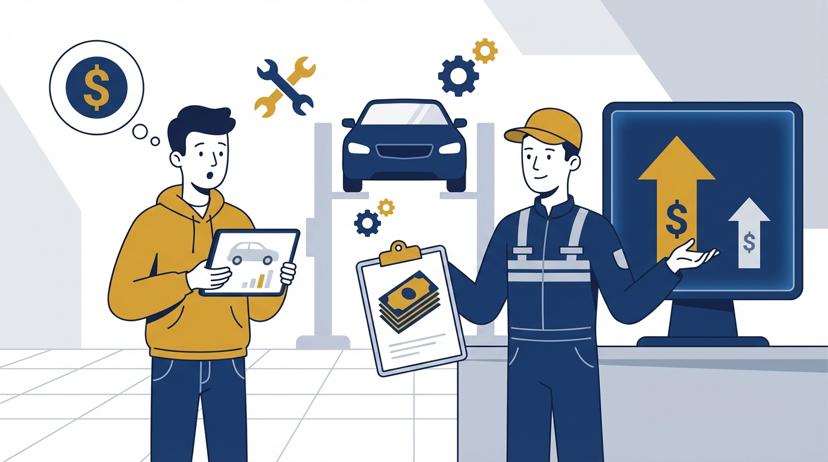
If your mechanic bill is higher than the estimate, you may not be legally required to pay the difference. Most states, including California and Florida, require shops to obtain your consent before performing additional work. If they fail to do so, the charges are often uncollectible under state consumer protection laws.
Key Takeaways
- Most states require written estimates and explicit authorization for any price increases.
- Verbal arguments and calling the police are rarely effective for civil repair disputes.
- A formal demand letter citing specific state statutes is the most effective way to seek a settlement.
- Shops often prioritize risk management over legal battles when faced with potential regulatory audits.
- Keep all documentation, including the original estimate and the final invoice, to use as evidence.
Few experiences are as frustrating as arriving at an auto repair shop to pick up a vehicle, only to find a mechanic bill higher than estimate. This scenario often begins with a verbal quote or a basic written work order for a specific repair, such as a brake replacement or a diagnostic check. However, when the final invoice arrives, it includes hundreds or even thousands of dollars in unauthorized labor and parts.
The immediate cost is financial, but the hidden costs are often more damaging. When a shop demands payment for work that was never authorized, they often hold the vehicle hostage. This creates a high-pressure environment where the consumer feels forced to pay just to get their car back for work or family obligations. In states like California and Florida, specific consumer protection laws exist to prevent this exact type of "bait and switch" pricing, yet many shops rely on the fact that most drivers do not know their rights.
A surprise bill also introduces the risk of a mechanic’s lien. If a consumer refuses to pay the inflated amount, the shop may threaten to keep the car indefinitely or even sell it to recover the costs. Understanding how to navigate a Mechanic Storage Fees Notice becomes a secondary battle that distracts from the original problem: the unauthorized charges. The stress of these disputes often leads consumers to make emotional decisions rather than strategic ones, which rarely results in a refund or a corrected bill.
Why "Status Quo" Solutions Often Fail
When faced with a bill that exceeds the original estimate, most people resort to one of three common tactics: arguing at the service counter, calling the police, or using a generic internet template to write a complaint. Unfortunately, these methods rarely produce a favorable outcome.
Arguing with a service advisor is often a dead end. Service advisors are trained to handle "sticker shock" and will frequently cite "unforeseen complications" or "necessary safety repairs" to justify the price hike. Without a formal, paper-based challenge that cites specific state regulations, verbal protests are easily ignored. Similarly, calling the police is usually ineffective. Law enforcement officers typically view auto repair disputes as civil matters and will inform the driver that they cannot force the shop to release the vehicle without payment.
The most common mistake, however, is using a generic "demand letter" template found on a random blog. These templates are often filled with aggressive, non-specific language that lacks legal weight. A shop owner who receives a letter that simply says "I will sue you" without citing the specific section of the California Automotive Repair Act or the Florida Motor Vehicle Repair Act knows the consumer is bluffing.
Furthermore, many consumers believe the only way to fix the problem is to file a lawsuit immediately. While court is an option, trials are slow, expensive, and often unnecessary. Small claims court should be viewed as a last resort. The goal is to resolve the dispute before a judge ever sees the case by using the rules of estimates and authorizations to push the shop to settle. If a consumer skips the formal demand process and goes straight to court, they may find themselves unprepared for the shop's defense. For example, knowing the California Small Claims Limits is important, but winning the case requires proof that the shop violated specific authorization protocols.
A New Approach: Strategic Consumer Advocacy
Resolving a dispute over a mechanic bill higher than the estimate requires a shift in strategy. Instead of focusing on the "unfairness" of the bill, the focus must shift to the "legality" of the invoice. Most states have strict "Estimate and Authorization" laws that dictate exactly how a shop must handle price increases.
In California, for example, Business and Professions Code Section 9884.9 requires a mechanic to provide a written estimated price for labor and parts. The shop cannot charge for work done or parts supplied in excess of the estimate without the oral or written consent of the customer. If a shop performs work without that consent, they are technically in violation of the law and may not be entitled to collect any payment for that unauthorized work.
The mechanism for success lies in a professional, statute-heavy Small Claims Demand Letter. A strategic demand letter does three things that a verbal argument cannot:
- Establishes a Paper Trail: It creates an objective record of the dispute, the original estimate, and the unauthorized overage.
- Cites Specific Codes: By referencing state-specific codes (like the Texas Deceptive Trade Practices Act or Florida's repair statutes), the letter signals to the shop that the consumer is prepared to take formal action.
- Changes the Math for the Shop: When a shop realizes that defending a $1,000 overcharge in court will cost them more in time, reputation, and potential fines from the Bureau of Automotive Repair (BAR), they are much more likely to offer a settlement or a refund.
This approach uses the shop's own documentation against them. If the shop cannot produce a signed authorization for the additional $500 in labor they tacked onto the bill, they are in a losing position. DemandDraft leverages this mechanism by generating tailored letters that focus on these technical rules. This can move the shop out of "customer service mode" and into "risk management mode."
Strategic Application: Pushing for a Resolution
To successfully challenge a bill that has ballooned past the estimate, a consumer should follow a structured process. The objective is to make settling the dispute the easiest and cheapest path for the mechanic.
Step 1: Secure the Evidence
Before leaving the shop or paying the bill, the consumer must obtain a copy of the final invoice and the original estimate. If the shop claims the authorization was "verbal," the consumer should ask for the exact time, date, and name of the person who supposedly gave that authorization. If no such record exists, the shop is in a precarious legal position.
Step 2: Identify the Overcharge Type
There are generally two types of overcharges. The first is "Labor Rate Inflation," where the shop charges more hours than the industry standard (often found in "Labor Guides" like Mitchell1 or AllData). The second is "Unauthorized Repairs," where the shop fixes things you didn't ask for. Knowing which one occurred allows for a more targeted demand. For instance, if a mechanic replaced a water pump while only authorized to change a belt, that is a clear-cut case of unauthorized repair.
Step 3: Send a Formal Demand
This is where the resolution happens. A formal letter should clearly state the facts: "The original estimate was $400. The final bill was $950. No authorization was provided for the $550 difference." By including a deadline for a response—typically 10 to 14 days—the consumer sets the pace of the negotiation.
Step 4: Leverage Regulatory Pressure
In many cases, mentioning a pending complaint with a state agency, such as the California Bureau of Automotive Repair, adds significant weight to the demand. Shops fear regulatory audits and "points" against their license far more than they fear a single small claims case.
Case Study: The "Safety" Trap
Consider a driver in Florida who took their car in for a $100 oil change and tire rotation. The shop called and said the car was "unsafe to drive" due to worn bushings and performed $800 in repairs without a written estimate. Under Florida law, the shop must provide a written estimate for any repair exceeding $100. By sending a demand letter that cited the Florida Motor Vehicle Repair Act, the driver was able to negotiate the bill back down to the original $100, as the shop realized their $800 repair was legally uncollectible because they bypassed the mandatory estimate phase.
Case Study: The "Teardown" Tactic
In Texas, a shop might disassemble a transmission and then tell the customer it will cost $3,000 to put it back together, far exceeding the initial "diagnostic" quote. This is often an attempt to trap the consumer. A strategic demand letter in this scenario would focus on the "unconscionable action" of the shop under the Deceptive Trade Practices Act (DTPA). When the shop sees the potential for "treble damages" (triple the amount of the claim) under the DTPA, they often suddenly find a way to lower the price or reassemble the vehicle at no cost.
Moving Toward a Resolution
A mechanic bill higher than the estimate is not a suggestion—it is a challenge to the consumer's rights. However, the solution is not to yell or to immediately spend months in the court system. The most effective way to get a refund or a corrected bill is to use the existing legal framework to create a professional, unavoidable demand for payment.
By focusing on the lack of authorization and the violation of state-specific repair acts, consumers can flip the script on the repair shop. The goal is to make the shop realize that keeping the extra money is more trouble than it is worth.
Start your demand letter to start the resolution process today.
Frequently Asked Questions
Can a mechanic charge more than the written estimate?
In many states, a mechanic cannot charge more than the written estimate without your prior oral or written consent. For example, California law requires a shop to get your approval before performing any work that exceeds the original quote.
What should I do if my car is being held hostage for an unauthorized bill?
You should request a copy of the signed authorization for the extra work. If they cannot provide it, inform them that they are in violation of state repair laws. You may need to pay 'under protest' to get your car back and then sue for a refund in small claims court.
Is a verbal estimate legally binding?
While verbal estimates exist, many states require a written estimate for repairs over a certain dollar amount (e.g., $100 in Florida). Proving a verbal estimate is difficult, which is why written documentation is always preferred.
Can I sue a mechanic for unauthorized repairs?
Yes, you can sue in small claims court for the return of money paid for unauthorized work. A strong demand letter sent before filing can often resolve the issue without a court date.
What is the California Automotive Repair Act?
It is a consumer protection law that requires auto repair dealers to provide written estimates and obtain authorization before starting work. Violations can lead to the shop being unable to collect payment and potential license revocation by the Bureau of Automotive Repair.