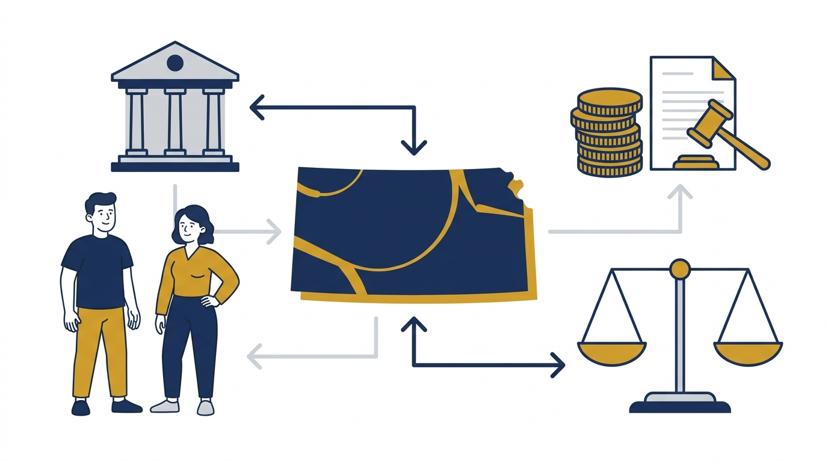
As of July 1, 2024, the small claims court limit in Kansas is $10,000. While you can sue for repairs or damages up to this amount, most disputes are resolved more efficiently by sending a professional demand letter citing the Kansas Consumer Protection Act (KCPA) to seek a settlement before a court date.
Key Takeaways
- The Kansas small claims court limit is $10,000 as of July 2024.
- Attorneys are generally not allowed in Kansas small claims hearings without special permission.
- The Kansas Consumer Protection Act (KCPA) allows for civil penalties up to $10,000 per violation.
- Filing fees in Kansas range from $35 to $55 depending on the claim amount.
- A professional demand letter is the most effective tool to trigger a settlement and avoid a trial.
Dealing with a mechanic dispute can quickly become an exhausting ordeal. Whether a shop performed unauthorized repairs or returned your vehicle in worse condition than when it arrived, the path to a resolution often feels blocked by confusing rules and high costs. As of July 1, 2024, the small claims court limit kansas is $10,000, providing a significant avenue for recovery. However, filing a lawsuit is rarely the most efficient way to get money back. Most consumers find that the real power lies in seeking a settlement before a judge ever sees the case. small claims court vs settlement
When a vehicle is stuck in a shop or a repair bill comes back thousands of dollars higher than expected, the stress is immediate. The vehicle is often a primary source of transportation for work and family. When a shop holds that vehicle hostage or performs shoddy work, the consumer loses more than just the repair cost; they lose time, wages, and peace of mind. While the $10,000 limit in Kansas covers most common repair disputes—from engine replacements to bodywork—the process of actually getting into a courtroom is slow.
In Kansas, small claims court is designed for simple cases. According to the Kansas Judicial Council, the filing fees are relatively low—$35 for claims under $500 and $55 for larger claims. But "low cost" does not mean "low effort." To successfully navigate this system, a consumer must:
- Serve the shop with legal papers via a process server or sheriff.
- Take time off work for mandatory hearings and potential mediation.
- Present a case that meets specific legal standards without the help of an attorney.
- Collect the judgment, as the court does not collect the money for you.
This is why many people find themselves stuck in a loop of frustration, unsure how to move the needle without spending months in the legal system.
Why "Status Quo" Solutions Often Fail
Most consumers start by trying to "talk it out" with the shop owner. While communication is important, verbal complaints are easily ignored. A shop owner might promise to "look into it" or offer a small discount that doesn't cover the actual damage. Without a formal paper trail, these conversations have no teeth. The mechanic knows that most people are intimidated by the idea of court and will eventually give up or pay the bill just to get their car back.
The next step many take is using a generic demand letter template found online. These templates are often too vague and use "legalese" that doesn't actually apply to the specific situation or the state in question. A shop that receives a generic letter knows it wasn't written by someone who understands the rules. It signals that the consumer is bluffing. why generic demand letters fail
Kansas has unique rules regarding legal representation in small claims. Attorneys are generally only allowed to represent parties if the court gives special permission or if the other side is also represented. This means the consumer is often standing alone against a business owner who may have been to court dozens of times. Relying on a weak template or a verbal argument puts the consumer at a massive disadvantage. To win, or better yet, to settle before court, the consumer needs to use the specific rules that govern auto repairs in Kansas.
A New Approach: The Professional Demand Mechanism
The most effective way to resolve an auto repair dispute is to move the conversation from "I'm unhappy" to "Here is what the consumer protection laws say." This is the core mechanism of DemandDraft. Instead of jumping straight to a lawsuit, the goal is to use a formal, professional demand letter that lays out the facts and the law.
By using a structured approach, the consumer shows the shop that fighting the claim could cost more than settling it. A professional demand letter serves as a "pre-litigation" tool. It shows the shop that the consumer has the proof and is prepared to go to court. When a shop sees a letter that cites the Kansas Consumer Protection Act (KCPA) and lays out each issue—from unauthorized labor to deceptive pricing—the dynamic changes.
This approach works because it targets the shop’s bottom line. Under Kansas law, certain violations can lead to civil penalties that far exceed the original repair bill. When a shop realizes they aren't just looking at a $1,000 refund, but potentially a $10,000 penalty plus the consumer’s attorney fees if the case escalates, they become much more motivated to fix the problem immediately. This is how you resolve a dispute without the "failure state" of a slow, expensive trial.
Strategic Application of Kansas Consumer Protection Laws
To effectively use a demand letter, one must understand how Kansas views auto repair disputes. Since Kansas does not have a single "Auto Repair Act," most disputes fall under the Kansas Consumer Protection Act (KCPA). This act is a powerful tool for consumers because it covers both "deceptive" and "unconscionable" acts. Kansas Consumer Protection Act overview
1. Deceptive Acts and Practices (K.S.A. 50-626)
A shop engages in a deceptive act if they willfully use falsehoods, exaggerations, or conceal material facts. Regarding auto repair, these violations typically occur when:
- No Written Estimate: If a shop performs work without ever providing a written estimate for parts and labor, they may be concealing material price terms.
- Misrepresented Parts: If a shop claims they installed new, original equipment manufacturer (OEM) parts but actually used second-hand or aftermarket parts, this is a violation of K.S.A. 50-626(b)(1).
- Unperformed Repairs: Charging for a service that was never actually done—such as a "transmission flush" where the fluid was never changed—is a classic deceptive practice.
2. Unconscionable Acts and Practices (K.S.A. 50-627)
An act is unconscionable if the shop takes advantage of a consumer’s inability to protect their own interests or if the price grossly exceeds what is reasonable.
- Unauthorized Repairs: If a consumer authorizes a $500 brake job and the shop performs $3,000 of engine work without calling for permission, this can be viewed as unconscionable. The shop is imposing an obligation the consumer never agreed to.
- Excessive Fees: If a shop charges storage fees that are triple the local average or stacks fees to coerce payment during a dispute, they may be violating K.S.A. 50-627.
- Holding the Vehicle Hostage: While Kansas allows for a mechanic's lien under K.S.A. 58-201, that lien only applies to lawful charges. Using a lien to hold a car over unauthorized or disputed fees can be an unconscionable practice.
3. The Power of the Private Remedy (K.S.A. 50-634)
The reason these statutes are so effective in a demand letter is the remedy they provide. Under K.S.A. 50-634, an aggrieved consumer can sue for their actual damages or a civil penalty of up to $10,000 per violation (as outlined in K.S.A. 50-636), whichever is greater.
Imagine a shop that charged $1,200 for unauthorized repairs. A demand letter shouldn't just ask for the $1,200 back. It should point out that the act of charging for unauthorized work is a violation of the KCPA, which carries a potential $10,000 penalty. This creates massive leverage. A shop is much more likely to refund the $1,200 immediately to avoid the risk of a $10,000 judgment in court.
Case Studies: Applying the Rules in Real Scenarios
Case Study 1: The "Surprise" Engine Rebuild
A consumer in Wichita took their truck in for a simple oil leak. The shop called and said the engine needed to be "freshened up" but didn't give a price. When the consumer went to pick up the truck, the bill was $6,500. The consumer never signed an estimate or gave a specific dollar limit.
By sending a demand letter citing K.S.A. 50-627, the consumer pointed out that the shop took advantage of their inability to protect their interests by performing work without a price agreement. The letter noted that under K.S.A. 50-634, the consumer could seek the $10,000 civil penalty. The shop, realizing they had no proof of authorization, agreed to reduce the bill to $2,000—the fair market value of the work—to settle the matter.
Case Study 2: The Used Part Scam
A driver in Overland Park paid for a new alternator. Two weeks later, the part failed. A second shop confirmed the alternator was a "pull" from a junkyard, not a new part. The original shop refused a refund, claiming "all sales are final."
The consumer used a demand letter to cite K.S.A. 50-626(b)(1)(C), which prohibits representing property as new when it is second-hand. The letter explained that this deceptive act triggered the private remedy under K.S.A. 50-634. Faced with the proof from the second shop and the threat of a civil penalty that was ten times the cost of the part, the shop issued a full refund and paid for the labor at the second shop.
Case Study 3: The Hostage Situation
A car owner disputed a $400 diagnostic fee that was never mentioned when the car was dropped off. The shop refused to release the keys until the fee was paid and began charging $50 per day in storage fees.
The consumer's demand letter cited K.S.A. 50-627, arguing that stacking storage fees on a disputed, unauthorized charge was unconscionable. It also referenced the Mechanic Storage Fees Notice concepts, explaining that a lien under K.S.A. 58-201 is only valid for authorized work. The shop released the vehicle and waived the fees within 24 hours of receiving the letter.
Navigating the Small Claims Process If Settlement Fails
While the goal is always to settle, understanding the small claims court limit kansas is vital for your backup plan. If the shop ignores a professional demand letter, the letter itself becomes your best piece of evidence in court. It shows the judge that you were reasonable, that you identified the specific laws violated, and that you gave the shop a fair chance to fix the mistake.
In Kansas, you must file your case in the county where the shop is located or where the transaction happened. You will fill out a "Small Claims Petition" and pay the filing fee. Remember that in Kansas, you cannot file more than 20 small claims cases in a single calendar year—a rule meant to stop debt collectors from clogging the system, but one that rarely affects individual consumers.
Preparation Checklist for Kansas Small Claims
Because attorneys are restricted in these hearings, your preparation is everything. You should organize the following items:
- The original work order or intake sheet.
- Any written estimates (or notes on the lack thereof).
- The final invoice showing the disputed charges.
- Photos and physical evidence of shoddy work or damaged parts.
- A copy of your demand letter and proof of delivery (e.g., certified mail receipt).
For more information on how to structure these arguments, you may want to review our Demand Letter Of Payment Guide. If you are dealing with a shop that has locations in other states, it can also be helpful to see how neighboring states handle these issues, such as in our Auto Repair Laws Missouri Guide.
The Advantage of a Professional Mechanism
The difference between a consumer who gets ignored and a consumer who gets a check is the perceived "cost of resistance." If a shop thinks you are just complaining, they will ignore you. If they think you are a prepared litigant with a deep understanding of the Kansas Consumer Protection Act, they will negotiate.
DemandDraft provides the professional structure needed to create this leverage. By focusing on the "rules of the road" for Kansas repairs, the platform helps consumers turn their frustration into a formal legal demand. This isn't about being "mean" or "aggressive"; it's about being accurate. When you cite K.S.A. 50-639 to explain that a shop cannot disclaim the implied warranty of workmanlike service, you are using the law as it was intended: to protect you from being taken advantage of.
Trials are slow, expensive, and often unnecessary. Most auto repair disputes are the result of a shop thinking they can get away with cutting corners or overcharging. A professional demand letter ends that assumption. It signals that the "failure state" of court is a real possibility for the shop—one that will cost them far more than simply doing the right thing.
Start your demand letter to start the resolution process today. Start your letter now.
Frequently Asked Questions
What is the maximum I can sue for in Kansas small claims court?
The current limit for small claims court in Kansas is $10,000.
Can I have a lawyer in Kansas small claims court?
Generally, no. Kansas law restricts attorneys from representing parties in small claims court unless the other party is an attorney or special permission is granted by the court.
What laws protect consumers against bad car repairs in Kansas?
Most auto repair disputes in Kansas are governed by the Kansas Consumer Protection Act (KCPA), which prohibits deceptive and unconscionable business practices.
How much does it cost to file a small claims case in Kansas?
Filing fees are $35 for claims under $500 and $55 for claims between $500 and $10,000.
Can a mechanic hold my car if I dispute the bill?
While Kansas allows mechanic's liens, they only apply to lawful, authorized charges. Holding a vehicle for unauthorized repairs or excessive fees may be considered an unconscionable act under the KCPA.