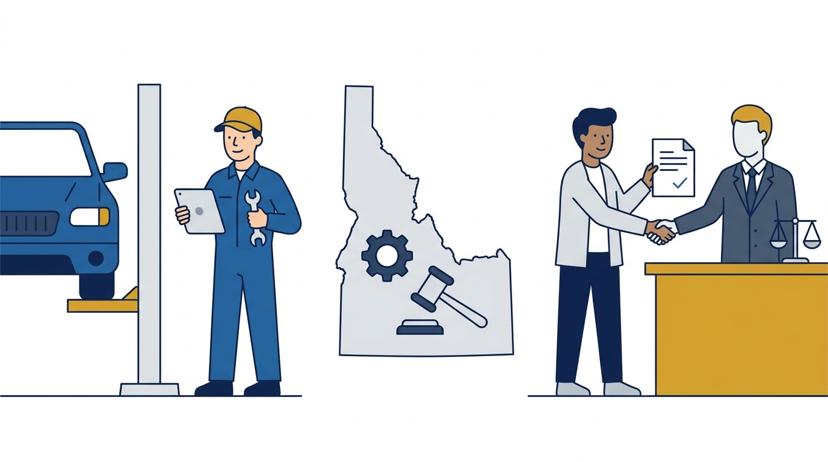
Idaho auto repair laws are primarily governed by the Idaho Consumer Protection Act (ICPA). It is illegal for shops to perform unauthorized repairs, fail to provide written estimates, or engage in deceptive practices. Consumers can seek actual damages or a $1,000 minimum penalty, plus mandatory attorney fees, making formal demand letters highly effective for settlement.
Key Takeaways
- The Idaho Consumer Protection Act (ICPA) is the primary legal tool for auto repair disputes.
- Performing repairs without a written estimate or prior authorization is a deceptive trade practice.
- Prevailing consumers can recover actual damages or $1,000, whichever is greater.
- Idaho law mandates that the court award reasonable attorney fees to consumers who win ICPA claims.
- A formal demand letter citing specific Idaho Code sections is the most effective way to seek a settlement.
The moment a mechanic calls with a price three times higher than the original quote, the relationship between a car owner and a repair shop changes. It shifts from a service agreement to a high-stakes negotiation. For many in the Gem State, the immediate reaction is either to pay the bill out of desperation or to threaten a lawsuit. However, the reality of the legal system is that trials are slow, expensive, and often unnecessary. When a vehicle is held hostage by a shop demanding payment for work that was never authorized or was performed poorly, the owner is not just fighting for their car; they are fighting against a lack of transparency.
Understanding auto repair laws idaho is the first step toward regaining control. Most consumers believe their only options are to pay up or go to court. This is a false choice. The legal framework in Idaho, specifically the Idaho Consumer Protection Act (ICPA), provides a third path. This path uses formal documentation and specific statutes to seek a settlement before a judge ever sees the case. By identifying exactly where a shop crossed the line—whether through a missing estimate or an unauthorized "extra" repair—a consumer can shift the leverage back in their favor.
The cost of a botched repair isn't just the invoice. It is the missed work, the rental car fees, and the stress of driving a vehicle that might still be unsafe. When a shop fails to fix a problem but still demands payment, they are betting that the consumer does not know the rules. Breaking that bet requires more than a heated argument in the lobby; it requires a strategic application of the law.
Why "Status Quo" Solutions Fail
Most people handle auto repair disputes in one of three ways: they argue with the manager, they leave a negative online review, or they file a small claims case. While these actions feel productive, they rarely result in a check being cut or a vehicle being released without payment. Arguing with a shop owner often leads to a stalemate where the shop exercises a "possessory lien" to keep the car. Leaving a review might hurt their reputation, but it doesn't put money back in the consumer's pocket.
Small claims court is often viewed as the ultimate solution, but it is actually a sign that the resolution process has failed. In states like Texas or New York, court dockets are backed up for months. Idaho is no different. Filing a lawsuit requires filing fees, service of process, and hours spent in a courtroom. Even if a consumer wins, they still have to collect the money, which is a separate and often more difficult battle. The goal should always be to resolve the dispute before it reaches a courtroom.
Generic demand letter templates found online often fail because they lack the "teeth" of specific state laws. A template that mentions general "fairness" is easy for a shop to ignore. A letter that cites specific sections of the Idaho Code and mentions the mandatory recovery of attorney fees is much harder to dismiss. When a shop sees that a consumer understands the specific penalties for deceptive trade practices, the cost-benefit analysis of fighting the consumer changes. The shop realizes that settling now is cheaper than losing in court later.
Understanding Auto Repair Laws Idaho: The Consumer Protection Shield
Idaho does not have a standalone "Motor Vehicle Repair Act" like some other states. Instead, auto repair disputes are governed by the Idaho Consumer Protection Act (ICPA). This is actually an advantage for the consumer. The ICPA is a broad, powerful tool designed to punish deceptive and unfair business practices. Under Idaho Code 48-603(17), it is unlawful to engage in any act that is misleading, false, or deceptive.
The Power of the Written Estimate
One of the most common violations involves the lack of a written estimate. If a shop performs work and bills a customer without first providing a written estimate for labor and parts, they have deprived the consumer of material price information. This is considered a deceptive practice under the ICPA. In this scenario, the consumer may have the right to treat the agreement as voidable. This means the shop may not be legally entitled to the money they are demanding.
Unauthorized Repairs and "Scope Creep"
Another frequent issue is when a shop starts with one repair but decides to perform three others without calling for permission. Idaho Code 48-603(16) makes it illegal to represent that repairs are needed when they are not, or to provide services that were never requested. If a mechanic replaces an alternator when the consumer only authorized an oil change, the shop has violated the law.
Consider a case where a driver in Meridian takes their truck in for a brake inspection. The shop discovers a leak in the power steering pump and replaces it without calling the owner. When the owner arrives to pick up the truck, they are hit with a $900 bill they never expected. Under the ICPA, this is a clear violation. The owner can use a Demand Letter Template Auto Repair to cite this specific statute, informing the shop that performing unauthorized work is a deceptive trade practice.
The $1,000 Minimum and Attorney Fees
The most significant leverage in Idaho law is found in Idaho Code 48-608. This statute provides a private remedy for consumers. If a consumer wins an ICPA claim, they are entitled to their actual damages or $1,000, whichever is greater. More importantly, the law mandates that the court award "reasonable attorney's fees" to a prevailing plaintiff.
This is the "nuclear option" in a demand letter. When a shop realizes that a $500 overcharge could turn into a $1,000 penalty plus $5,000 in attorney fees, they are much more likely to settle. The risk of losing a small dispute becomes a massive financial liability for the business. This is why citing the correct Idaho statutes is essential; it turns a simple complaint into a legal threat the shop's insurance or legal counsel will take seriously.
A New Approach: The Formal Demand Letter
The superior way to resolve an auto repair dispute is to use a formal, well-organized demand letter. This is the mechanism DemandDraft utilizes. Instead of simply asking for a refund, the letter cites specific statutes and sets a hard deadline for a response. It moves the dispute from the "customer service" category to the "legal liability" category.
The logic is simple: provide the shop with a way out that is cheaper than the alternative. If a shop has charged for a Mechanic Charged Diagnosis Not Fixed situation, the demand letter points out that under Idaho Code 48-603(5), representing that a service has benefits it does not actually have (like "fixing" a car that is still broken) is a violation.
The demand letter serves as "proof" that the consumer attempted to resolve the matter in good faith. If the shop ignores the letter and the case eventually does go to court, the judge will see that the shop was given a fair chance to fix the problem and refused. In Idaho, this can lead to discretionary punitive damages for "repeated or flagrant" violations under Idaho Code 48-608.
Strategic Application: How to Use the Rules
To successfully resolve a dispute, a consumer must gather their evidence and apply the law to the facts. Here is how to handle common scenarios using Idaho's legal framework.
Scenario 1: The "Hostage" Vehicle
If a shop refuses to release a car because the owner refuses to pay for unauthorized work, they are exercising a possessory lien under Idaho Code 49-1701. However, this lien is only valid for compensation to which the shop is "legally entitled." If the work was unauthorized or the shop committed a deceptive practice under the ICPA, they are not legally entitled to that compensation.
The strategy here is to inform the shop in writing that their retention of the vehicle is an abuse of the lien. By citing the ICPA catch-all provision (48-603(17)), the consumer can argue that holding the car to extract an unlawful charge is itself a deceptive practice. This often prompts the shop to release the vehicle in exchange for a partial payment or a signed agreement to mediate.
Scenario 2: Poor Workmanship and New Damage
When a shop fixes one thing but breaks another, they have breached their "duty of care." In Idaho, a repair shop is considered a "bailee for hire." This means they have a legal obligation to take reasonable care of the vehicle. If they return the car with a new dent or a "weed smell" that wasn't there before, they are liable for those damages.
Under common law negligence and Idaho Code 6-1604, a consumer can seek compensatory damages to fix the new problem. If the shop tries to hide the damage or lies about how it happened, this triggers the ICPA again. A demand letter should list the specific new damages and include a quote from a different shop to fix them. This shows the mechanic that the consumer is prepared to prove the exact dollar amount of the harm caused.
Scenario 3: The Bait-and-Switch
If a shop advertises a "Complete Brake Job for $99" but tells every customer who walks in that their rotors are "dangerously thin" and must be replaced for $600, they may be engaging in bait-and-switch tactics. Idaho Code 48-603(9) and (10) specifically prohibit advertising services with the intent not to sell them as advertised.
If a consumer suspects this is happening, they should ask for their old parts back. While Idaho doesn't have a specific statute requiring the return of parts unless requested, failing to return them after a request is made can be used as evidence of a deceptive practice under the ICPA catch-all. It suggests the shop is hiding the fact that the parts they replaced were actually in good condition.
Common Pitfalls to Avoid
The biggest mistake consumers make is waiting too long to put their demands in writing. Verbal agreements are difficult to prove. In Idaho, the Attorney General's Rules of Consumer Protection treat the omission of material facts—like the final cost of a job—as deceptive. If there is no paper trail, the shop can claim the consumer gave "oral authorization."
Another pitfall is paying the full bill "under protest" without a written reservation of rights. If a consumer pays the bill just to get their car back, the shop may argue that the payment constituted an acceptance of the work and the price. A better approach is to send a demand letter immediately, or if payment is necessary to get the car, to write "Paid under protest - dispute to follow" on the check or invoice.
Finally, many people forget that the ICPA allows for the recovery of "costs." This includes the money spent on a second opinion or the cost of towing the vehicle to a competent shop. These should all be itemized in the demand letter to show the shop the full extent of their financial exposure.
The Path Forward
Resolving a dispute with an Idaho mechanic does not have to involve months of litigation. By using the Idaho Consumer Protection Act as a lever, consumers can move the needle in their favor. The goal of a formal demand letter is to present the facts so clearly and the legal consequences so starkly that the shop chooses the path of least resistance: a fair settlement.
The rules are there to protect the consumer, but they only work if they are invoked. Whether it is a lack of a written estimate, unauthorized repairs, or defective workmanship, Idaho law provides a clear path to a remedy. Using a structured, statute-based approach turns a frustrating situation into a manageable legal process.
Start your demand letter to start the resolution process today. Start your letter now.
Frequently Asked Questions
Can a mechanic in Idaho charge more than the estimate?
Under the Idaho Consumer Protection Act, failing to provide a written estimate or charging for unauthorized 'extra' work is considered a deceptive practice. You may not be legally obligated to pay for work you did not authorize.
What can I do if an Idaho mechanic holds my car hostage?
While shops have possessory liens, they are only valid for compensation they are 'legally entitled' to. If the shop committed a deceptive practice or performed unauthorized work, you can argue the lien is invalid under Idaho Code 48-603.
Do I need a lawyer to sue a mechanic in Idaho?
No, you can represent yourself in small claims court. However, because Idaho law allows for the recovery of attorney fees in consumer protection cases, hiring a lawyer may be feasible as the shop may have to pay your legal costs if you win.
What is the penalty for deceptive auto repairs in Idaho?
Per Idaho Code 48-608, consumers can recover their actual financial losses or a statutory minimum of $1,000. Courts may also award punitive damages for repeated or flagrant violations.
Should I pay the bill if I disagree with the repair quality?
If you must pay to get your car back, write 'Paid under protest' on the invoice or check. This helps preserve your right to dispute the charges later through a demand letter or legal action.